
NEWS
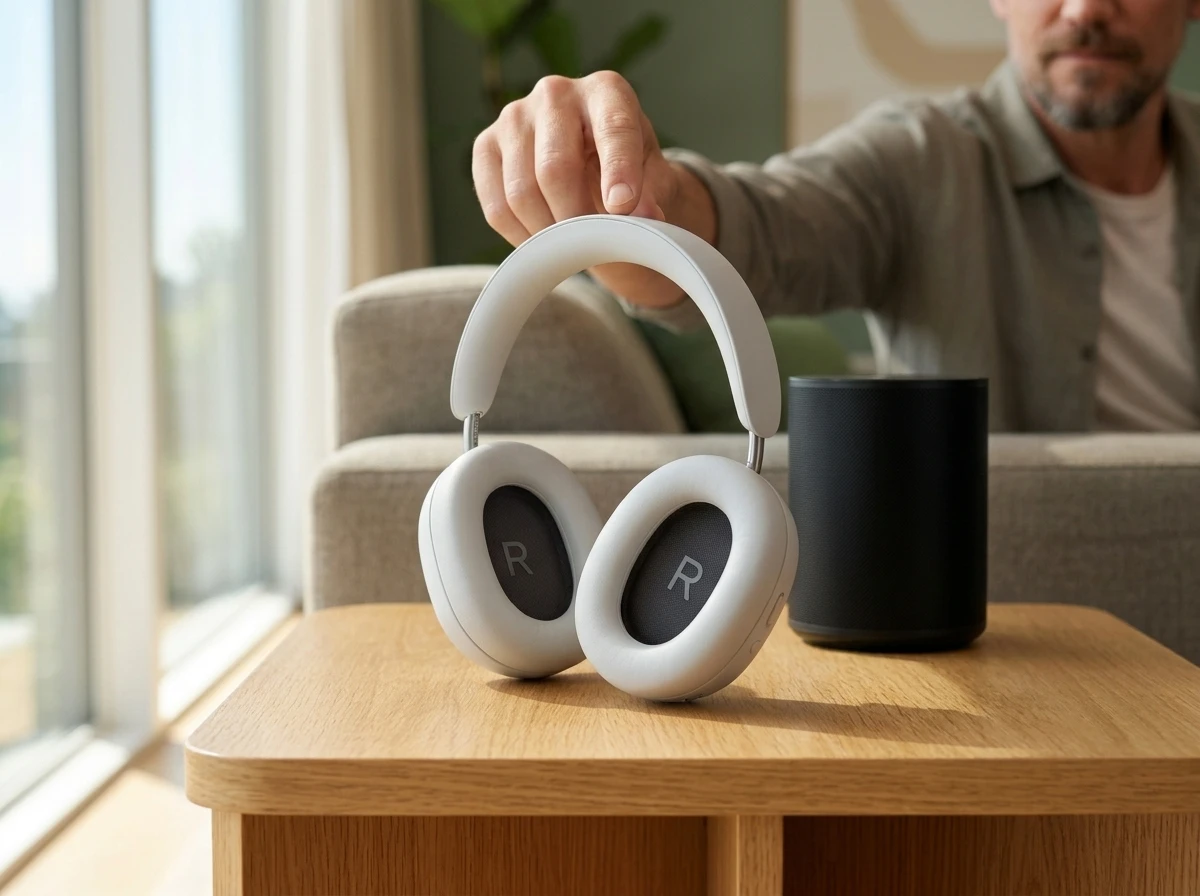
Sonos Ace Ultra Filing Hints at Headphones That Join the Home System
FCC documents for Sonos Ace Ultra list five new colors and network tests ahead of the September launch.

Sonos filed FCC documents this week for over-ear headphones labeled Ace Ultra (model S52a), listing five colors and local-network radio tests that go beyond the original Ace. The filing landed days after CEO Tom Conrad confirmed an early September product launch event focused on conversational computing in the home.
The company did not respond to comment requests. The documents stay heavily redacted, yet the visible pieces already sketch a different product than the black-and-white Ace that arrived in 2024.
What the Redacted Filing Shows
One exhibit includes an oval diagram of what appears to be an ear cup marked Sonos Ace Ultra. The name follows the Arc Ultra soundbar pattern. Color callouts name Greige (light gray), Shadow Black, Agave, Blush and Sand.
| Aspect | Original Ace | Ace Ultra filing |
|---|---|---|
| Model | S26 / Ace | S52a / Ace Ultra |
| Colors | Black, Soft White | Greige, Shadow Black, Agave, Blush, Sand |
| Network tests | Bluetooth + limited TV swap | 2.4 GHz and 5 GHz local networks noted |
| Voice | None native | Hints of Sonos Voice Control support |
The network language could simply extend the TV Audio Swap feature that already lets Ace headphones pull sound from a Sonos soundbar. It could also mean the Ultra can join a Sonos Wi-Fi system more like a speaker, streaming music without a phone in the middle.
Engadget and Lowpass both flagged language that points to on-device Sonos Voice Control processing. The original Ace never got that assistant. Adding it would let a wearer say “Hey Sonos” and group rooms, change volume, or move playback without touching a phone.
Taken together, the visible radio tests and the voice hints point in the same direction. The Ultra filing sketches a product meant to live on the home network rather than visit it only for a TV handoff. That reading still depends on unredacted details, but the labels already diverge from the first Ace’s narrower profile.
September Event Meets the AI Home Pitch
On the July 29 earnings call Conrad said the company would host a product launch event in early September. He framed it as the first public look at a year of product work built around conversational computing and predictive intelligence.
Conversational computing and predictive intelligence are moving into the home, and Sonos brings to this moment twenty years of solving the hard problems the home uniquely creates: sound, form, systemness, and intelligence.
That line comes straight from the Conrad preview of the September event. He stressed that models will become commodities. The lasting edge, he argued, sits in the hardware and the system that already knows a home’s layout and habits. Headphones that can hear a command and act across the house fit that thesis cleanly.
The installed base he cited: more than 53 million connected devices in more than 17 million homes. Turning personal headphones into another native node expands that surface.
The timing is deliberate. A September stage gives Sonos a single moment to tie hardware, voice, and system membership to the same story Conrad told on the call. The FCC paper trail now supplies a candidate product that can carry that story in wearable form.
The Original Ace Left Gaps That Still Rankle
Sonos launched the Ace in June 2024 at $449. Reviews praised comfort, build and ANC, yet many noted it fell short of Sony and Sennheiser rivals on pure noise canceling and app polish at the time. The bigger problem was timing. The Ace arrived alongside a botched app redesign that angered longtime owners and delayed other products.
The headphones themselves never fully behaved like a Sonos speaker. They could not appear as a zone in the app for multi-room groups the way an Era or Roam can. TV swap worked with Arc, Beam and later Ray, but everyday music stayed in the Bluetooth lane. Owners on forums and social threads repeatedly asked for deeper system membership.
- Launch price $449, now listed at $399 on the official shop
- 30-hour battery with ANC, rapid charge to three hours in three minutes
- Spatial audio with dynamic head tracking and Dolby Atmos
- Bluetooth multipoint, wear detection, lossless over Bluetooth or USB-C
- TV Audio Swap with supported soundbars, but no full Wi-Fi zone status
Those current Ace specs and TV Audio Swap details show a capable premium pair that still felt like an accessory rather than a core Sonos product. Sales reportedly lagged internal targets in the first year, and the company later cut production plans sharply. Price cuts and software updates helped the Ace improve, yet the first version never became the volume driver Sonos needed.
The gap was structural, not cosmetic. Comfort and battery life won praise, yet the product still asked owners to treat music and home control as separate jobs. That split is the complaint the Ultra filing appears built to answer.
Five Colors Signal a Broader Buyer Hunt
Sonos has long stuck to black and white (or soft white) across most of its lineup. The Roam 2 received extra finishes, but headphones stayed monochrome. Greige, Agave, Blush and Sand move the Ace Ultra into lifestyle territory closer to Bose, Sony and Apple’s color ranges.
The shift is not cosmetic only. A wider palette lowers the barrier for shoppers who treat headphones as personal fashion as much as audio gear. It also gives retailers more shelf stories and gift options heading into the holiday window that follows the September event.
If the Ultra keeps the Ace’s comfort and build while adding the missing system features, the colors become the visible sign that Sonos wants new households, not just upgrades from existing owners.
Monochrome gear reads as utility. Five named finishes read as choice. For a company that already sells into more than 17 million homes, that choice is a way to put the same system story in front of people who never browsed the black-and-white Ace.
Why Existing Homes Care About Network Reach
For the 17 million homes already running Sonos, the second-order question is control. A pair of headphones that can run local voice recognition and stay on the home network turns every wearer into a walking remote for the whole system. Volume in the kitchen, grouping the patio, swapping movie audio without hunting for a phone: those become voice or one-touch actions.
That capability also tightens lock-in. Once headphones act as a first-class citizen, leaving the Sonos system means losing a personal listening layer that knows the house. Competitors selling standalone ANC cans cannot match that without building an equivalent multi-room stack.
Memory-chip cost spikes remain a live headwind. Conrad said higher memory prices cut roughly $14 million from Q3 Adjusted EBITDA. The company is optimizing software memory use and weighing pricing carefully so it does not scare off new households. Any Ultra that packs more radio and on-device ML will feel those component costs.
Network reach is the difference between a private listening device and a portable control surface. The filing’s 2.4 GHz and 5 GHz notes matter because they open the path to that second role. Without it, voice commands stay trapped on the headphones. With it, a wearer can aim those commands at the whole house.
Financial Backdrop and the Bar for Launch Day
The same Q3 that previewed the event delivered solid numbers. Revenue hit Q3 revenue of $375 million, up 9 percent year over year and near the high end of guidance. Adjusted EBITDA rose 24 percent to $44 million. Gross margin held near the top of the range even after absorbing the memory hit. The company returned $30 million to shareholders via buybacks.
| Q3 measure | Result |
|---|---|
| Revenue | $375 million, up 9% year over year |
| Adjusted EBITDA | $44 million, up 24% |
| Memory cost impact | Roughly $14 million hit to Adjusted EBITDA |
| Shareholder returns | $30 million via buybacks |
Growth accelerated from the 2 percent pace of the first half. Management pointed to stronger marketing, geo-expansion and a rebuilt app navigation that customers helped shape. Amp Multi for custom installers ships later in August. The September event is meant to show the next wave of hardware that makes the software and AI story tangible.
Open questions the filing cannot answer:
- Final price relative to the $399 Ace
- Whether Wi-Fi streaming works as a full Sonos zone or only for limited features
- Battery life impact of continuous on-device voice detection
- Exact ANC and codec upgrades versus the original
- Availability timing after the event reveal
Crowd reaction on X has been measured so far. Several tech accounts noted the five colors and hoped the Ultra finally fixes the system-integration shortfall that defined the first Ace. Others simply listed it as another premium rival to the upcoming Sony WH-1000XM6 generation. The quiet consensus is that features matter more than another pretty can.
The Path From Ace Launch to September
The public record already lays out a short sequence that frames what the Ultra must do.
- June 2024: Sonos launches the Ace at $449 with strong comfort and build notes, limited system membership, and no native voice assistant.
- First year after launch: Sales lag internal targets, production plans are cut, and the price moves to $399 on the official shop while software updates arrive.
- July 29: Conrad uses the earnings call to preview an early September event built around conversational computing and predictive intelligence.
- Later in August: Amp Multi for custom installers is due to ship, extending the hardware wave before the stage event.
- This week: FCC documents surface for Ace Ultra model S52a with five colors and broader local-network radio tests.
- Early September: The launch event is set to give the first public look at that year of product work.
Each step tightens the brief. The first Ace proved the company could ship premium headphones. The app rebuild and return to growth rebuilt room to try again. The filing now suggests the second try will be judged on network membership and voice, not on finish options alone.
On Device Voice Ties the Wearable to the House
Conrad’s September pitch treats models as commodities and puts the lasting edge in hardware that already understands a home. On-device Sonos Voice Control is the mechanism that makes that claim concrete for headphones. Processing stays local, so a wearer can issue commands without routing every phrase through a phone handset.
The practical chain is simple. The headphones hear “Hey Sonos.” They act on grouping, volume, or playback moves across rooms the system already knows. TV Audio Swap already showed a limited version of that handoff with Arc, Beam, and Ray. Full local voice plus network presence would extend the same idea from a single swap into steady control.
That is also why the battery and cost questions on the open list matter. Continuous listening for a wake phrase and extra radio hardware both pull power and component budget. The company is already managing a roughly $14 million memory-related hit to Q3 Adjusted EBITDA and says it is optimizing software memory use. An Ultra that adds radios and on-device ML has to clear the same discipline on price so it does not scare off the new households the five colors are meant to attract.
For owners, the payoff is fewer trips to a phone screen. For Sonos, the payoff is another native endpoint inside the more than 53 million connected devices already counted across the installed base.
What Success Looks Like After the Reveal
If the Ace Ultra arrives with true network membership and private voice control, it closes the loop Conrad described: every form factor of sound in the home, designed to work as one. Headphones stop being a Bluetooth sideline and become another intelligent endpoint. Colors pull in buyers who never considered the monochrome Ace. Existing owners gain a personal layer that actually talks to their speakers.
If the Ultra ships as a mostly Bluetooth refresh with prettier finishes, the second-order opportunity slips. The original Ace already proved that good sound and comfort are not enough when the system story stays incomplete. Sonos has spent two years fixing the app, rebuilding trust and returning to growth. The September stage is where that work either shows up in a product people can wear or remains a slide deck promise.
The filing gives the clearest public signal yet that the company understands the gap. Early September will show whether the hardware matches the ambition.

-
 TECH1 year ago
Where Garmin Watches are Made and How They are Assembled
-

 AUTO2 months ago
Tesla’s Roadster Is ‘a Few Weeks Away,’ Says Its Chief Designer
-
 NEWS10 years ago
Samsung Releases Galaxy Note7 TV Ad as Reddit AMA Leaks Specs
-
 NEWS10 years ago
Android 7.0 Nougat Rolls Out To Nexus Devices With New Emoji, Features
-
 FINANCE9 years ago
Cardano Price Surges as ADA Enters the Crypto Top Ten List
-
 NEWS10 years ago
Pre-Order the First Camera Made for Facebook Live Streaming Video
-
 FINANCE1 year ago
Binance Suspends Trading and Withdrawals for a System Upgrade
-
 FINANCE9 years ago
RChain Price Jumps Nearly 150% to a New All-Time High of $2.03