
BUSINESS
Chandrasekaran Exit Revives Old Tata Trusts Clash Pattern
After a six-month board deadlock with Noel Tata, N Chandrasekaran declines reappointment and tells staff to ignore gossip, echoing past Trusts-Sons friction.

Natarajan Chandrasekaran told the Tata Sons board on Wednesday he will not seek reappointment when his term ends on February 20, 2027, ending nine years as chairman after a six-month deadlock over a five-year extension. At a Bombay House town hall the same afternoon he urged employees to ignore the gossip and conspiracy theories now swirling around the transition.
The 63-year-old framed the choice as necessary for clarity. Strategic projects sit at critical stages, he said, and leadership uncertainty harms employees, investors and partners alike.
The Boardroom Deadlock That Forced the Call
Sir Dorabji Tata Trust and Sir Ratan Tata Trust had unanimously recommended a five-year extension. The Tata Sons Nomination and Remuneration Committee and board recorded that support. The resolution reached the full board on February 24, 2026.
One director withheld support. Without unanimous backing, Chandrasekaran chose to defer rather than force a vote. Six months later no resolution existed. He informed the board he would not offer himself for reappointment and asked it to name a successor soon for an orderly handover.
- July 2025: Tata Trusts unanimously resolve to back a five-year extension for Chandrasekaran.
- February 24, 2026: Tata Sons board tables the resolution; one member blocks it; decision deferred.
- May 2026: Constructive board meeting reviews Air India, BigBasket and other concerns without resolving the chair term.
- August 12, 2026: Chandrasekaran declines reappointment and addresses employees at Bombay House.
According to contemporary reporting, four of the six directors backed the extension. Noel Tata, the opposing voice, sought conditions that included a permanent bar on listing Tata Sons, tighter limits on high-risk ventures, and clearer containment of losses at certain group companies.
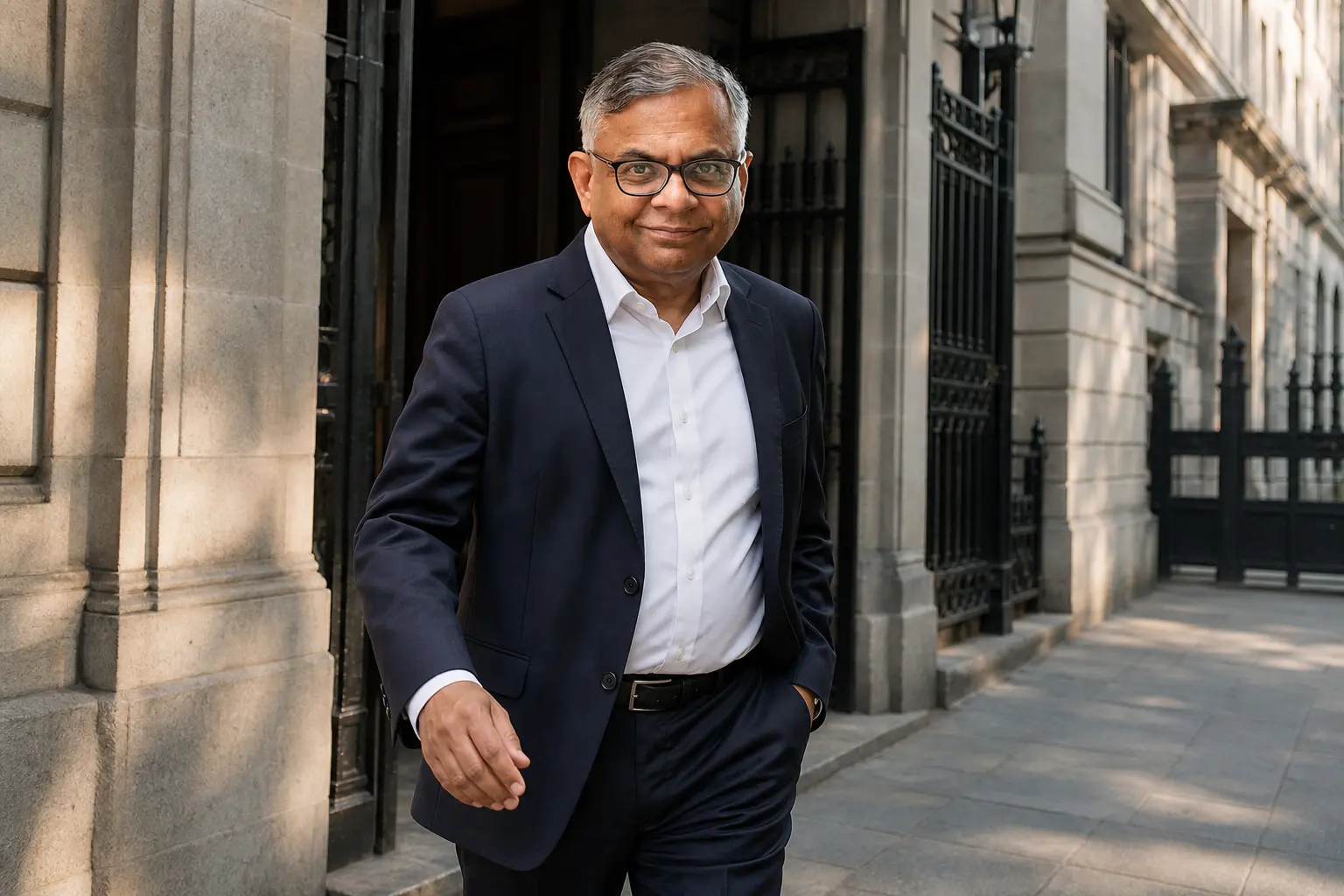
What He Told Employees at Bombay House
Chandrasekaran opened the town hall by acknowledging the public reports. “As you might have read or be aware, am not seeking reappointment after February 2027 as term comes to an end,” he said, per people present.
He spoke of four decades inside the group and said he could never have dreamed where the career would take him. Every professional journey ends, he noted, and another leader will step in. “Tata is a revered name and that is because of the efforts of employees like you.”
Do not pay much attention to the gossip, theories, conspiracies that you hear.
That line, reported by attendees and carried by Fortune India and PTI, drew the strongest reaction. He closed by saying he hoped to know more employees individually rather than only in large gatherings. The room gave him a standing ovation and thunderous applause as he left. One account placed the meeting at the Starbucks inside Bombay House and quoted him stressing that the organisation is bigger than any individual.
How Nine Years Reshaped the Group
Chandrasekaran joined Tata in 1987, spent three decades at TCS, and led that company as CEO from 2009 to 2017. Under him TCS became India’s most valuable company. He took the Tata Sons chair in early 2017 after the boardroom rupture that removed Cyrus Mistry.
At group level he pushed what the official TCS leadership page calls the One Tata strategy of simplification scale and synergy. The approach produced consolidations, demergers and large new bets.
| Move | Outcome or status |
|---|---|
| Air India acquisition and merger with Vistara/AirAsia India | Airline back in Tata fold; fleet and operations still rebuilding |
| Tata Consumer Products creation | Combined tea, salt and pulses platform now valued near ₹1.14 lakh crore |
| Tata Motors PV/CV separation and Iveco deal | Sharper focus; commercial-vehicle expansion underway |
| Electronics, semiconductors, battery giga-factories | New manufacturing verticals including Pegatron stake |
| BigBasket and 1mg acquisitions | Digital consumer push still loss-making in places |
He also chairs multiple operating boards and holds civilian honours including the Padma Bhushan and France’s Légion d’Honneur. The same period brought scrutiny: Air India operational setbacks and a fatal crash, pricing pressure and headcount cuts at TCS, and a cyber incident at Jaguar Land Rover.
The Trusts-Sons Pattern Repeats
Philanthropic trusts hold 66% of the equity share capital of Tata Sons, the private holding company that promotes more than 30 operating firms. After Ratan Tata’s death in 2024, his half-brother Noel N. Tata is the Chairman of the Tata Trusts. That shift placed family ownership control in Noel’s hands while operational leadership stayed with Chandrasekaran, a professional manager with no Tata bloodline.
The February clash therefore carried echoes of 2016. Then the Trusts and Sons fought a public battle over strategy and board power that ended Mistry’s chairmanship and damaged the group’s reputation. Last year fresh friction already appeared over board seats, strategy and the planned exit of minority shareholder Shapoorji Pallonji. Noel’s conditions on listing and capital allocation sat inside that longer argument about who sets the risk appetite for a conglomerate whose brand rests on both commercial scale and philanthropic ownership.
Crowd reaction on X treated the stock drop as confirmation that investors still price Tata governance risk the same way they did a decade earlier. One widely shared joke simply noted that when Chandra said he was stepping down, the entire Tata share family seemed to follow him out the door.
Who Feels the Shock First
Markets reacted before the town hall ended. Tata group stocks erased roughly 433 billion rupees, or $4.5 billion, in market value on the day.
- TCS: fell as much as 5.7 percent, leading the decline.
- Tata Motors Passenger Vehicles: dropped about 4.1 percent.
- Tata Consumer, Tata Elxsi, Tata Communications, Tata Steel, Titan: losses between 1.7 and 2.9 percent.
Employees heard a personal reassurance that opportunities inside the group would continue. Investors and partners heard that succession must now accelerate. Minority shareholder Shapoorji Pallonji still needs an exit path; any listing discussion remains frozen by the very conditions that helped stall Chandrasekaran’s extension. Operating companies mid-turnaround, especially Air India and the newer digital and electronics bets, lose the continuity of the chairman who launched them.
Succession Clock Starts Now
Chandrasekaran will serve out the remaining months until February 20, 2027. He has asked the board to decide on a successor promptly so the transition stays orderly. No name has emerged. Possible paths include another long-serving professional, a Trusts-aligned figure, or a hybrid arrangement that shortens the next term, an idea Noel floated earlier when he proposed two years instead of five.
The AGM scheduled for August 18 arrives with the chair already a lame duck on the reappointment question. For a group that sells stability as part of its brand, the next six months will test whether the ownership-operations balance can produce a clean handover or whether the 2016 template of prolonged tension reasserts itself. Chandrasekaran’s final public message to staff was simple: the name Tata outlasts any single career. The market and the board now have to prove it.

-
 TECH1 year ago
Where Garmin Watches are Made and How They are Assembled
-

 AUTO2 months ago
Tesla’s Roadster Is ‘a Few Weeks Away,’ Says Its Chief Designer
-
 NEWS10 years ago
Samsung Releases Galaxy Note7 TV Ad as Reddit AMA Leaks Specs
-
 NEWS10 years ago
Android 7.0 Nougat Rolls Out To Nexus Devices With New Emoji, Features
-
 FINANCE9 years ago
Cardano Price Surges as ADA Enters the Crypto Top Ten List
-
 NEWS10 years ago
Pre-Order the First Camera Made for Facebook Live Streaming Video
-
 FINANCE1 year ago
Binance Suspends Trading and Withdrawals for a System Upgrade
-
 FINANCE9 years ago
RChain Price Jumps Nearly 150% to a New All-Time High of $2.03