
ENTERTAINMENT
Netflix’s AI Reveal Puts India’s Low-Cost VFX Workforce in Play
Netflix’s SEC filing names India’s boxing drama Glory among 300 AI-assisted titles, spotlighting the low-cost VFX workforce Hollywood has relied on for years.

Netflix told shareholders on Thursday that generative AI touched roughly 300 of its movies, shows and specials released in 2026, and one of the three titles the company named outright was Glory, the Hindi-language boxing drama shot in Haryana. The disclosure sat inside a routine second-quarter earnings letter filed with the Securities and Exchange Commission on July 16, next to $12.56 billion in quarterly revenue.
In Los Angeles, the number is being read as a story about cost and craft. In Mumbai, it lands on an industry already arguing over who does the work AI is now doing, and how much of that work has quietly belonged to India for two decades.
Netflix Puts a Number on Its AI Habit
Netflix’s shareholder letter said generative AI workflows have been used in roughly 300 of its titles so far this year, spanning everything from concept art and pre-visualization through post-production and release. The company framed it as routine infrastructure, not experimentation.
Revenue for the quarter came in at $12.56 billion, up 13.4% year over year, with net income of $3.4 billion, or 80 cents a share. Netflix’s shareholder letter filed with the SEC disclosed the AI figure, and analysts polled by LSEG Data and Analytics had expected $12.59 billion in revenue and 79 cents a share, Variety reported. Shares slipped as much as 9% in after hours trading, a reaction tied to slowing subscriber growth and the narrow revenue miss rather than the AI news itself.
Co-CEO Ted Sarandos told analysts the company is not trying to replace the people who make its shows. “We believe it takes great artists to make something great, and AI is not changing that,” he said. “Movies are being made by people who make movies. AI provides them with better tools to make them even better.”
Three titles got called out specifically: Glory, the Brazilian soccer miniseries Brasil 70: A Saga do Tri, and the American Revolutionary War docuseries The American Experiment. Sarandos said AI helped assemble “highly complex sequences,” including bigger crowds and battle scenes that the budgets otherwise would not have covered.
| Title | Setting | What Netflix Said AI Helped Build |
|---|---|---|
| Glory | Haryana, India, boxing drama | Complex sequences cited alongside enhanced crowd work |
| Brasil 70: A Saga do Tri | Brazil, soccer miniseries | Historical crowds and match-day sequences |
| The American Experiment | United States, Revolutionary War docuseries | 17 minutes of AI-enhanced footage, produced twice as fast at half the cost |
Behind the disclosure sits a $600 million bet. Netflix bought Ben Affleck’s AI startup InterPositive in March, bringing over a roughly 16-person team whose tools work directly on existing footage, relighting shots and automating edits rather than generating video from a text prompt. Divide the price by the headcount and it works out to roughly $37.5 million per person. Alongside InterPositive sits Eyeline, Netflix’s in-house visual effects studio, which built the company’s first generative AI shot in a finished production back in 2025: a building-collapse sequence in the Argentine series The Eternaut, completed about ten times faster than conventional visual effects work.
Why Did Glory Need AI at All?
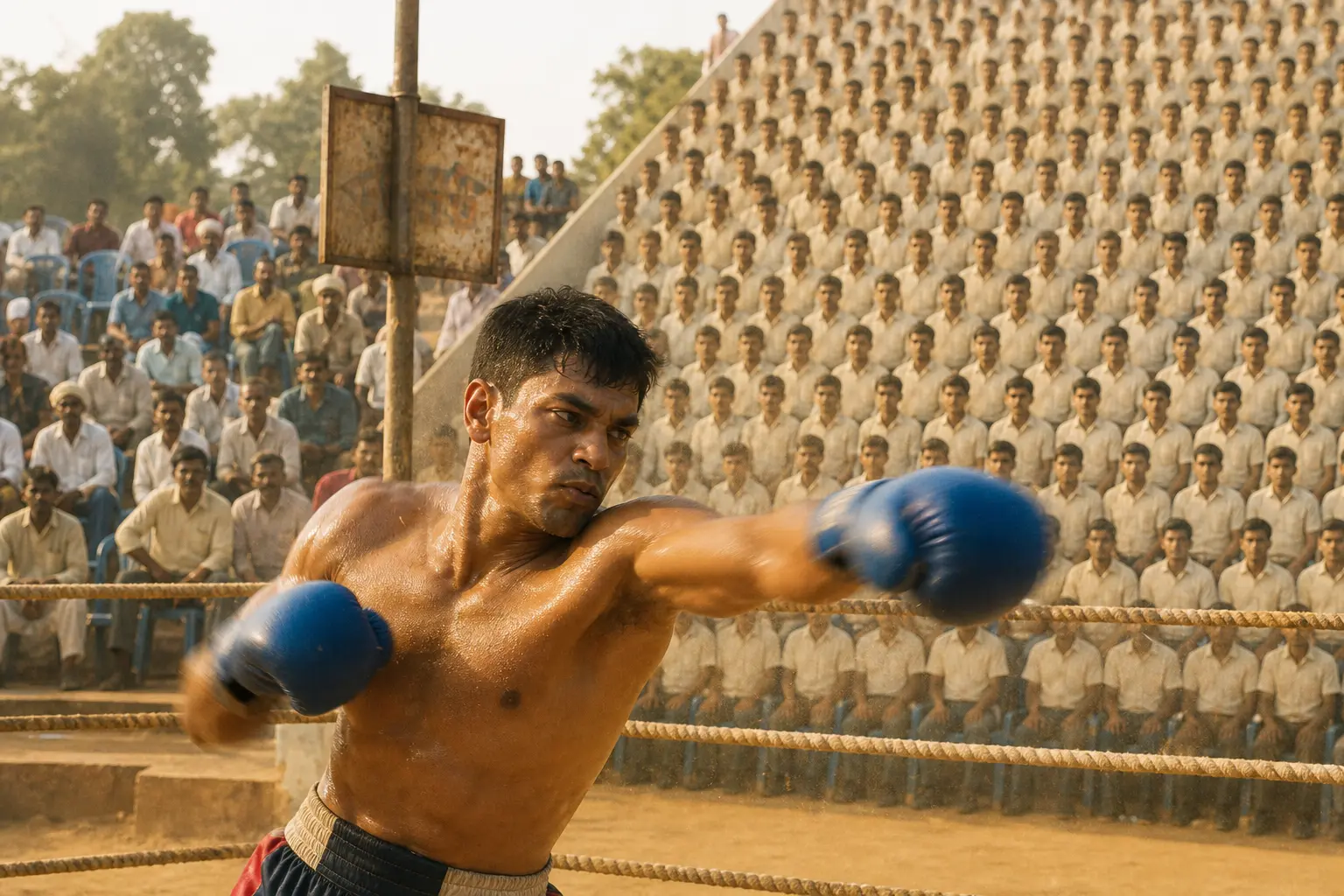
Glory needed AI to make its arenas look full without paying for the crowd. The Netflix series, released on May 1, follows a boxer’s rise through Haryana’s amateur circuit alongside a family feud and a murder investigation, and it stars Divyenndu, best known internationally for playing Munna Tripathi in Mirzapur, alongside Pulkit Samrat and Suvinder Vicky.
Netflix did not break out which effect belongs to which title. But arena and stadium scenes are exactly the kind of shot Indian productions have historically trimmed first, because paying, dressing and choreographing hundreds of background extras for a few minutes of screen time is expensive anywhere, and more so on budgets a fraction of a Hollywood tentpole’s. If AI let Glory’s boxing crowds look the size a Hollywood arena scene would, that is the budget math Sarandos was describing when he said productions “would’ve left out those key shots because they wouldn’t have been able to afford them.”
India Was Already Mid-Fight Over AI
Netflix’s number did not land in a vacuum. Twelve days earlier, television producer Ekta Kapoor was already fielding backlash over an AI-generated Lord Krishna who appeared opposite Smriti Irani’s character in a prison scene on the long-running soap Kyunki Saas Bhi Kabhi Bahu Thi. Clips of the sequence circulated widely, and social media users mocked the visual effects almost immediately.
That followed JioStar’s AI-generated adaptation of the Mahabharat, produced through Collective’s AI lab and streaming since October. The series had logged at least 26.5 million views by this year, yet sits at 1.4 out of 10 on IMDb, with reviewers pointing to lip-sync errors and sequences that looked cheap. A senior JioStar executive described the reaction as a mix of appreciation and healthy debate.
The pattern goes back further than either. Here is how the last year of flashpoints lines up:
- July 2025: Netflix confirms its first generative AI shot in a finished production, a building-collapse sequence in The Eternaut built by Eyeline Studios.
- August 2025: Eros International rereleases a Tamil dub of Raanjhanaa with an AI-altered happy ending, drawing public criticism from star Dhanush.
- March 2026: Netflix acquires Ben Affleck’s InterPositive for up to $600 million.
- July 4, 2026: Ekta Kapoor’s Kyunki Saas Bhi Kabhi Bahu Thi draws backlash over its AI-generated Krishna scene.
- July 16, 2026: Netflix discloses roughly 300 titles used generative AI in 2026, naming Glory among them.
Dhanush had called the Raanjhanaa ending a move that “stripped the film of its very soul” and set a troubling precedent. Netflix’s disclosure simply gave that ongoing argument a hard number to point at.
The Workforce Behind India’s Cut-Rate VFX Edge
India built a real industry on doing this work by hand, cheaply, for other people’s movies. Roto, paint and matchmove work, the labor-intensive frame-by-frame cleanup that underpins most modern visual effects, has for years been concentrated in lower-cost markets, India chief among them, according to an analysis from HDRI Consulting. The same analysis expects AI-driven disruption to hit those roles in India sooner than in North America, Britain or Europe, precisely because that is where the labor-intensive, lower-margin work sits.
The industry was already contracting before Netflix said a word about AI. India’s VFX segment shrank 14% in 2024, according to a FICCI-EY report on the media and entertainment sector, even as India’s overall media and entertainment market grew to roughly $29.4 billion. That same report expects AI to generate significant portions of full-length films within three to five years, effects, backgrounds and character animation included.
Not every corner of the industry reads that as bad news. State governments are still selling animation and VFX as a jobs engine. At the Bengaluru GAFX event this year, Karnataka’s chief minister said the state’s games, animation and visual effects sector could create 20 lakh jobs over the next five years, while urging companies to use AI ethically. Whether those are the same jobs AI is expected to compress elsewhere in the pipeline is the part nobody has answered yet.
The Money Argument Nobody in Mumbai Is Losing
Set the labor anxiety aside and the financial case for adoption looks straightforward to the people writing checks. Consulting firm EY projects AI could lift Indian media and entertainment revenue by 10% and cut production costs by 15% over the medium term, a framing that has already moved capital. Bollywood production house Abundantia Entertainment has committed an $11 million investment in its own AI studio, with founder Vikram Malhotra expecting AI-generated or AI-assisted work to account for a third of the company’s revenue within three years.
Vijay Subramaniam, founder and group chief executive of Collective Artists Network, has made the budget case in blunter terms. Speaking about mythological epics that would otherwise require building entire digital cities, he described the trade-off this way:
Can you realistically make a $200 million film in India today? Probably not, because the screen capacity cannot support that level of budget. So, if the technology allows you to tell the same scale of story for $50 million instead of $200 million, everything changes.
Bollywood director Anurag Kashyap has voiced unease about AI’s spread without clear guardrails, but he does not pretend the economics are close. “In India, cinema isn’t about art. It’s purely business, so studios are going to use it to make mythologicals,” he said, adding that Indian audiences are receptive to the results.
India’s outsourcing giants are running a version of the same wager on the software side. TCS, Infosys and Wipro have leaned into a services-first AI strategy built without a frontier model of their own, betting that execution and cost still beat owning the underlying technology. India’s VFX houses are being pushed to make the identical bet, only with cameras and crowds instead of code.
Guardrails for Footage, Silence on Jobs
Netflix has published rules for partners who use AI on its productions, and they are about content protection, not employment. Studios working with Netflix must:
- Disclose any intended use of generative AI tools before they touch a production.
- Protect talent likenesses and personal data from unauthorized AI manipulation.
- Clear third-party intellectual property before it enters an AI-assisted workflow.
Nothing in that list addresses what happens to the artists whose roto, paint and crowd-building work the tools are designed to shrink. That silence matters more in India than in the American or European markets HDRI Consulting flagged, because India is the market absorbing both ends of the trade at once: the productions gaining access to effects they could never afford, and the workforce whose labor made those effects possible in the first place.
Netflix’s next shareholder letter is due in October. Whether the 300-title figure climbs again will be counted in Los Angeles. Whether the artists who used to fill Glory’s boxing arenas by hand are still on the call sheet is a number nobody has published yet.

-

 AUTO1 month ago
Tesla’s Roadster Is ‘a Few Weeks Away,’ Says Its Chief Designer
-
 NEWS10 years ago
Samsung Releases Galaxy Note7 TV Ad as Reddit AMA Leaks Specs
-
 NEWS10 years ago
Android 7.0 Nougat Rolls Out To Nexus Devices With New Emoji, Features
-
 FINANCE9 years ago
Cardano Price Surges as ADA Enters the Crypto Top Ten List
-
 NEWS10 years ago
Pre-Order the First Camera Made for Facebook Live Streaming Video
-
 FINANCE12 months ago
Binance Suspends Trading and Withdrawals for a System Upgrade
-
 FINANCE9 years ago
RChain Price Jumps Nearly 150% to a New All-Time High of $2.03
-
 NEWS10 years ago
Google Play App Icons Get Fresh New Look: See the Latest Design Update