
BUSINESS
India Presses US as New Visa Rule Squeezes Students’ Options
DHS’s new fixed-term visa rule shortens stays for Indian students and quietly closes the second master’s route many used after losing the H-1B lottery.

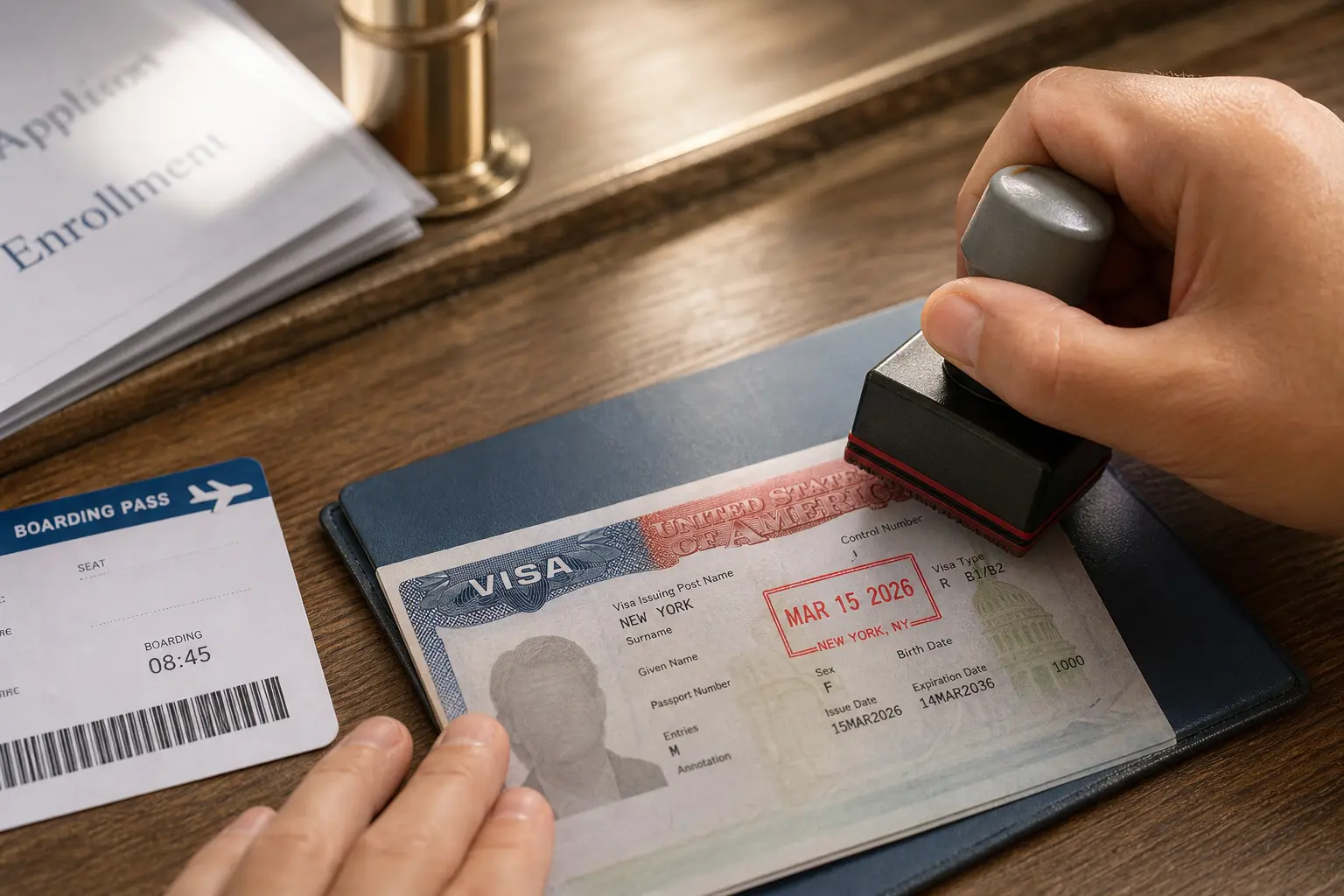
India told Washington this week it is working to soften the fallout for Indian students from a new US visa rule that ends decades of open-ended stays. The regulation covers foreign students, exchange visitors and journalists holding F, J and I visas, and it takes effect September 15, 2026. It also cuts the grace period graduates get to leave the country, transfer schools or change status, from 60 days to just 30.
Indian officials have kept their public comments narrow, framing this as routine consular diplomacy. The rule’s reach goes well beyond graduation paperwork. It closes a same-level re-enrollment option that thousands of Indian graduates have used for years to keep working in the United States after losing the H-1B lottery.
The End of Open-Ended Stays
Since 1978, most F-1 students, J-1 exchange visitors and I-visa media workers entered the United States under a system called duration of status. Their Form I-94 carried a “D/S” notation instead of an expiration date, letting them stay as long as they kept up with their program.
The Department of Homeland Security (DHS), the federal agency that oversees immigration enforcement, ended that system in a final rule published July 17 in the Federal Register. F and J holders now get a fixed admission period tied to their program length, capped at four years. I-visa holders, mostly foreign journalists, get up to 240 days, cut to 90 days for anyone carrying a passport from mainland China outside Hong Kong or Macau.
| Visa Category | Old Admission Basis | New Fixed Period | Grace Period After Completion |
|---|---|---|---|
| F-1 (students) | Duration of academic program, no end date | Program length, capped at 4 years | 30 days, down from 60 |
| J-1 (exchange visitors) | Duration of exchange program | Program length, capped at 4 years | Extension filing required beyond program end date |
| I (foreign media) | Duration of assignment | Up to 240 days (90 for mainland Chinese passport holders) | Extensions in matching increments; employer or medium change needs approval |
Anyone who needs more time must now file directly with US Citizenship and Immigration Services (USCIS), pay a $420 extension fee, submit biometrics and prove they still qualify, a process the old system never required.
DHS Blames Decades of Fraud
DHS Secretary Markwayne Mullin cast the change as a security fix. “For nearly half a century, the outdated ‘duration of status’ system has compromised national security and created an environment ripe for immigration fraud,” Mullin said in the agency’s July 16 announcement of the final rule. He added that decades of open-ended enrollment let some students avoid ever leaving by continually re-enrolling in courses.
The rule’s own preamble points to specific cases. One nonimmigrant entered the country as an F-1 student at a dance school in 1991 and was still enrolled three decades later, in 2021, though the program was designed to run five years.
The Center for Immigration Studies, a think tank that supported the change, tallied more than 2,000 F-1 holders still active decades after arrival. At least 2,134 of them entered the country between 2000 and 2010 and were still in that status as of April 2026.
DHS’s own rulemaking materials cite the scale of the population it says grew too large to track case by case: more than 1.8 million student-visa admissions, over 500,000 exchange-visitor entries and 37,300 media-visa admissions.
The Loophole That Just Closed for H-1B Hopefuls
Buried in the rule is a restriction that matters more to Indian tech workers than the four-year cap. Graduates who finish one program can no longer re-enroll in another at the same or a lower level while staying in F-1 status. They must move up a level instead.
That change is one of several new limits on academic mobility written into the final rule, and it closes a well-worn backup plan. Indian graduates who lose the annual H-1B lottery have often had a fallback: enroll in a second master’s degree through a program known as Day 1 Curriculum Practical Training, or CPT.
The lottery itself caps at 65,000 visas, plus another 20,000 reserved for US advanced-degree holders. Day 1 CPT lets a student start working in their field from the first day of a new program, buying another shot at the lottery without leaving the country.
For anyone who already has a master’s degree, they are not going to be able to go back and say, ‘I need another master’s degree because I need work authorization to continue working’
Danielle Goldman, co-founder and chief executive of the talent platform Build, said that of the proposed changes earlier this year.
- Extension of Stay applications now go directly to USCIS, with biometrics and a fresh eligibility check.
- Graduate students cannot change their stated educational objective mid-program.
- Graduate transfers between schools require special approval from the Student and Exchange Visitor Program, not routine sign-off.
- Anyone finishing one program must move to a higher level, not repeat the same or a lower one.
- English-language training programs are capped at 24 months in total.
Each item turns a process that used to run through university offices into one that runs through a federal case officer.
India’s Students Feel the Sharpest Exposure
Roughly 360,000 Indian nationals were enrolled in US institutions in 2024-25, the largest national cohort of any country studying in America. A sizable share sit in PhD, research or other programs that run past four years, precisely the group now most exposed to repeated extension filings.
The exposure compounds a pipeline that was already thinning. One analysis of State Department visa data found new F-1 issuances to Indian nationals fell 60% during the summer of 2025, compared with the year before. That decline fits a wider slide. A NAFSA-linked survey of 149 US institutions tied it to a 24% average drop in new foreign graduate enrollment this spring.
NAFSA, an association representing international educators, spells out the compliance load the new rule places on schools: tracking I-94 expiration dates, filing extensions before students slip out of status. Its chief executive, Fanta Aw, put the stakes in blunter terms. “At a time when global competition for talent is intensifying, this policy sends exactly the wrong message,” she said. “It tells the world’s brightest students and scholars that the United States is becoming less welcoming, less predictable, and less committed.”
Where Experts Disagree
- DHS and the Center for Immigration Studies say fixed terms close fraud gaps that let some students stay enrolled for decades without real oversight.
- NAFSA and university international offices warn the rule makes America a harder sell against Canada, the UK and Australia in the race for global talent.
- Immigration attorneys and platforms like Build say the deeper cost lands on STEM graduates who used a second degree as a bridge after losing the H-1B lottery.
Each camp is reading the same 240 pages of regulatory text and arriving at a different bottom line.
This Rule Failed Once Before, in 2020
Washington tried almost this exact change six years earlier. The first Trump administration proposed ending duration of status in 2020, and the Biden administration withdrew that proposal in July 2021 before it ever took effect, according to the Center for Immigration Studies analysis.
The revival moved through the federal rulemaking pipeline in stages, arriving alongside a broader run of visa restrictions that had already begun denting enrollment. Foreign student enrollment for the 2026 spring semester fell 20% from the year before, and universities in Asia and Europe picked up students the US pipeline used to claim.
The Office of Management and Budget signed off on the new rule’s final text on June 17, 2026, clearing the way for publication a month later. Because DHS classified the rule as major, it now sits under formal congressional review, giving lawmakers a window to challenge it before the September 15 start date.
What Is New Delhi Asking Washington to Change?
India is not contesting Washington’s right to set its own immigration rules. It is asking US officials to fix individual hardship cases for genuine students and travelers as they surface. That narrow request shaped nearly everything India’s foreign ministry said in public this week.
Randhir Jaiswal, spokesperson for India’s Ministry of External Affairs, addressed the rule at a briefing on Friday after reporters asked about the Department of Homeland Security’s changes. “We’ve seen some reports regarding the visa rules. Visa rules and visa functions and immigration matters are sovereign functions of any state,” Jaiswal said.
He added that New Delhi still intervenes case by case. “But having said that, let me tell you that as and when there are issues of difficulties, which are brought to our attention, in regard to genuine travellers [and] students, among others, who seek support from the US, we take up those issues with the US side so as to minimise the difficulties that our people face,” Jaiswal said.
The Countdown to September 15 Has Begun
Current F and J holders admitted under duration of status do not need corrected paperwork the day the rule takes effect. They keep their status through their program end date or up to four years from September 15, 2026, whichever comes first, plus a departure window afterward. For F students, that transition period runs no later than November 14, 2030.
Travel complicates that math. A student who leaves the country and comes back after September 15 immediately falls under the new fixed-date system, regardless of what protection the transition rules would otherwise have given them.
Congress could still amend or block the rule under its review authority before the effective date arrives. DHS said in the Federal Register notice that it will publish a new document if that timeline changes. For now, the clock for every new F, J and I arrival starts on September 15.
Frequently Asked Questions
Does the new rule end OPT or STEM OPT for Indian graduates?
No. DHS has said the rule does not fundamentally change Optional Practical Training, STEM OPT or Curriculum Practical Training. Graduates can still apply for that post-study work authorization, though an Extension of Stay filing may be required alongside it if their fixed admission period runs out first.
Will this change H-1B visa processing too?
Not directly. H-1B cap-gap protection, which keeps a graduate’s work authorization active while an H-1B petition is pending, remains in place. But the fixed admission periods add pressure to line up OPT timing, extension filings and H-1B sponsorship earlier in a graduate’s first job.
Can graduate students still transfer schools or switch majors?
Only with extra approval, and undergraduates face a lower bar than graduate students do. The final rule bars graduate-level F-1 students from changing their stated educational objective mid-program and requires Student and Exchange Visitor Program sign-off for most transfers, a tighter standard that does not apply the same way to undergraduates.
What changes for journalists and other media workers on I visas?
Beyond the shorter 240-day, or 90-day, admission period, I-visa holders now need USCIS permission before switching employers or changing the type of outlet they work for, a step the old duration-of-status system never required.
Could the September 15 start date still move?
Yes. The rule is classified as a major rule subject to congressional review, and DHS has said it will publish an updated notice if the effective date shifts or the rule is blocked before then.

-

 AUTO1 month ago
Tesla’s Roadster Is ‘a Few Weeks Away,’ Says Its Chief Designer
-
 NEWS10 years ago
Samsung Releases Galaxy Note7 TV Ad as Reddit AMA Leaks Specs
-
 NEWS10 years ago
Android 7.0 Nougat Rolls Out To Nexus Devices With New Emoji, Features
-
 FINANCE9 years ago
Cardano Price Surges as ADA Enters the Crypto Top Ten List
-
 NEWS10 years ago
Pre-Order the First Camera Made for Facebook Live Streaming Video
-
 FINANCE12 months ago
Binance Suspends Trading and Withdrawals for a System Upgrade
-
 FINANCE9 years ago
RChain Price Jumps Nearly 150% to a New All-Time High of $2.03
-
 NEWS10 years ago
Google Play App Icons Get Fresh New Look: See the Latest Design Update