
NEWS
Sarawak Greenlights 405-Hectare Kuching AI Data Campus at Tanjung Embang

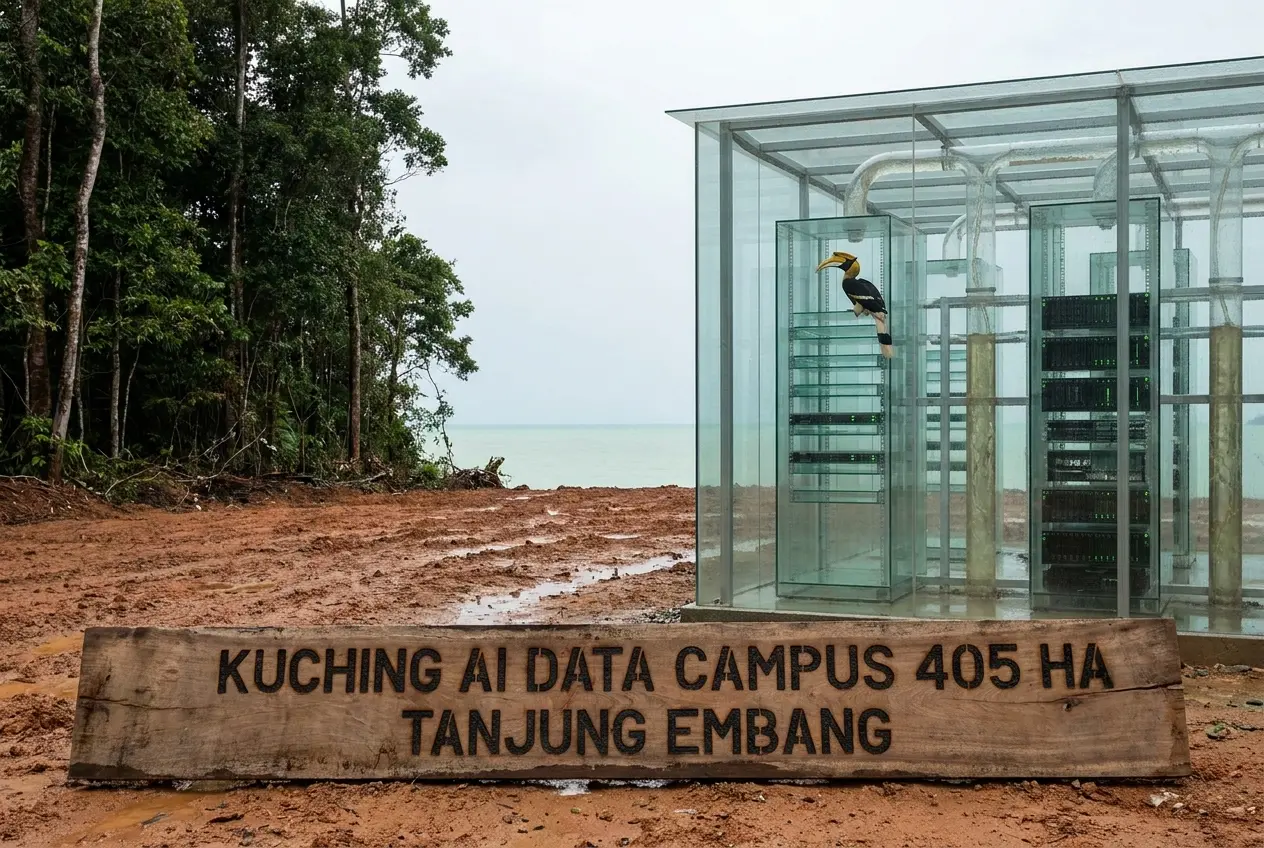
Sarawak’s government will build a 405-hectare artificial intelligence data campus at Tanjung Embang on the outskirts of Kuching, Premier Tan Sri Abang Johari Tun Openg announced on May 3, 2026, after touring the K2 Strategic Data Centre Campus in Dublin. The project, branded the Kuching AI Data Campus, will run as a public-private partnership and break ground with a 120-hectare first phase, the Sarawak Public Communications Unit (Ukas) confirmed in its statement on the Premier’s working visit to Ireland.
The announcement lands at an unusual moment. Five days earlier, on April 29, the same Premier publicly predicted that conventional data centres could be obsolete within five years, replaced by a satellite-fed AI Grid. He is now committing one of the largest publicly disclosed land tracts ever earmarked for AI infrastructure in Southeast Asia to a model he himself has questioned.
The 405-Hectare Bet Behind Sarawak’s Newest Data Play
The campus will sit inside the wider Tanjung Embang growth corridor in Samarahan Division, a coastal stretch already lined up to host a new international airport, a deep-sea port roughly eight kilometres offshore, a gas terminal, and a low-carbon industrial estate. The site reserved for the data campus is more than three times the footprint of the average hyperscale facility in Malaysia.
Abang Johari said the campus will be equipped with dedicated power and water supply, and will be modelled on the K2 facility he visited outside Dublin. The Premier was briefed by K2 Strategic founder and chief executive Kuok Meng Wei, the Singapore-based grandson of tycoon Robert Kuok, alongside chief operating officer Kuan Zhan Peng.
Phase one alone covers 120 hectares, the equivalent of about 168 international football pitches, and it is meant to start before the federal Aerotropolis funding cycle for the new airport closes.
Why the Premier Picked Dublin as the Template
Dublin was not a random stop. K2 Strategic, the Kuok Group’s data centre arm, has built its entire identity around the Irish capital, where four of its operating campuses sit on the same suburban grid that powers Microsoft, Google, AWS, and Meta’s European cloud regions. The K2 DUB 5 facility alone runs at 15.36 MW of IT load, and the firm’s Kingswood Drive campus is now its flagship hyperscale build.
For Sarawak, the appeal is the cold-climate, liquid-cooled, low-PUE design philosophy K2 has refined in Ireland, retrofitted for a tropical equatorial site. The state wants to copy the engineering, not the weather.
| Site | Operator | Power Profile | Notes |
|---|---|---|---|
| K2 DUB 1 to DUB 5, Dublin | K2 Strategic (Kuok Group) | Up to 15.36 MW per facility | Template for Tanjung Embang |
| K2 Johor (Iskandar Puteri) | K2 Strategic | 60 MW | K2’s first Malaysia campus |
| FutureData Sarawak Park | FutureData | 17 MW first phase, 500 MW planned | Already has a signed off-taker |
| Kuching AI Data Campus, Tanjung Embang | PPP, partner not yet named | Not disclosed | 120 ha phase one, 405 ha total |
The Five-Year Obsolescence Warning Hanging Over Tanjung Embang
The Premier’s own April 29 remarks complicate his May 3 ribbon. Speaking at a state digital event, Abang Johari said data centres “would no longer be relevant in the next five years” as AI systems shift to satellite-linked cloud architectures and what he called an EU-style AI Grid, with Italy and Spain cited as early movers.
“If we use between 100 to 200 megawatts of energy, we need to consider the returns,” the Premier said, in remarks first reported by Free Malaysia Today.
That is a striking thing for the same office to say a week before unveiling a 405-hectare campus. It also reframes Tanjung Embang as a hedged bet rather than a pure data centre play. By calling the site a “data campus” rather than a single hyperscale facility, the state leaves itself room to bolt on AI Grid nodes, satellite ground stations, and edge-compute pods as the architecture shifts.
State officials have begun describing the campus as “a catalyst for an AI Grid,” language that did not appear in the Dublin briefing readout but did appear in the earlier DayakDaily report on the obsolescence speech. Read together, the two announcements suggest the state is buying optionality on the next compute paradigm.
The Premier laid out three AI generations in the same April speech: generative AI, agentic AI, and what he called strategic AI, which he expects to reshape governance itself. The Kuching campus is meant to host all three on the same plot.
Whether tenants share that view is the open question. None has been named.
Inside the K2 Pitch: Kuok’s Grandson Wants $9 Billion in Southeast Asia
The man who briefed Abang Johari is not just an executive. Kuok Meng Wei runs K2 Strategic as a wholly owned subsidiary of the Kuok Group, the Robert Kuok empire that already touches palm oil, sugar, hotels, and shipping across the region. Under Meng Wei, the group has committed roughly 9 billion US dollars to data centre buildout across Southeast Asia over the next five years.
That capital target is what makes the Sarawak conversation more than a state-level press release.
- $9 billion. K2’s stated five-year capital budget for Southeast Asia data infrastructure.
- 60 MW. The capacity of K2’s first Malaysia site, in Johor’s Iskandar Puteri zone.
- 4 campuses. The Dublin footprint Sarawak is now copying, including K2 DUB 1 through DUB 5.
- 120 hectares. The Tanjung Embang phase one tract that K2 or a peer would need to anchor.
How the Campus Plugs Into the Tanjung Embang Megaproject
The data campus is one tile in a larger mosaic. Tanjung Embang itself spans roughly 110 square kilometres and is being designed by Singapore urban-planning firm Morrow Architects and Planners to host an eventual population of 500,000, a new central business district, an industrial estate, and the relocated Kuching International Airport.
That broader plan was already public. Premier Abang Johari confirmed in April 2025 that the master plan for the airport and deep-sea port was in its final stages, with the airport designed for 15 million passengers a year and the seaport sitting eight kilometres offshore.
- 110 km². Total Tanjung Embang growth zone footprint.
- 500,000. Targeted future population for the new city district.
- 15 million. Annual passenger capacity of the new international airport.
- 8 km. Offshore distance of the planned deep-sea port.
What the data campus adds is a compute anchor. Aerotropolis-style developments around the world, from Songdo to Doha, have struggled to fill industrial-zone land without a digital tenant. Putting a 405-hectare AI campus inside the master plan gives the airport, port, and gas terminal a baseload customer for power, fibre, and water from day one.
It also pulls forward the build schedule. Phase one’s 120 hectares would, in practice, need fibre backhaul, substation tie-ins, and water-treatment capacity that the rest of the megaproject is still costing.
Power, Water, and the Bakun Calculation
Sarawak’s pitch to hyperscalers has always been the same line: cheap, abundant, low-carbon hydropower. The state’s Bakun Hydroelectric Plant generates 2,520 MW and, in 2025, became the largest hydro facility in Southeast Asia certified under the International Hydropower Association’s Hydropower Sustainability Standard.
Abang Johari has gone further, telling investors at the ASEAN energy roundtable that Sarawak intends to keep at least 60% of its energy mix renewable by 2030, with a 10 GW capacity target. The Kuching AI Data Campus is the first major industrial customer announced under that framework.
- 2,520 MW. Generation capacity of the Bakun Hydroelectric Plant.
- 10 GW. Sarawak’s 2030 renewable capacity target.
- 60%. Minimum renewable share of the state’s 2030 energy mix.
- 3 GW. Additional hydropower potential identified across cascading dam sites.
Sarawak vs Johor: Malaysia’s Data Center Map Is Splitting in Two
Until this week, Malaysia’s data centre story was a Johor story. The southern state, helped by land priced at up to 60% below Singapore, jumped from 10 MW of installed capacity to roughly 1,500 MW in three years and now hosts close to 80% of the country’s live IT capacity. The headline tenants are Microsoft, AWS, Google, and Oracle, who together have committed about 23.3 billion US dollars to Malaysian cloud and AI infrastructure.
Sarawak is now positioning itself as the renewable-energy alternative for AI workloads that cannot stomach Johor’s grid mix or its rising water-stress headlines. FutureData’s 500 MW park in Sarawak, with a 130 million US dollar first phase and a signed off-taker, has been the proof point. Tanjung Embang multiplies that footprint by an order of magnitude.
| Metric | Johor | Sarawak |
|---|---|---|
| Live IT capacity (2026) | ~1,500 MW | Sub-50 MW today |
| Power source | National grid, gas-heavy | Hydropower-led |
| Land cost vs Singapore | Up to 60% cheaper | Lower still, state-allocated |
| Anchor tenants | Microsoft, AWS, Google, Oracle | FutureData, Kuching AI Campus pending |
| Water risk | Rising scrutiny | Abundant, river-fed |
The split matters because hyperscalers are increasingly being forced by their own scope-2 emissions targets to source compute from renewable grids. Sarawak’s Bakun-anchored mix gives it a structural pitch Johor cannot easily match.
Frequently Asked Questions
Where exactly is the Kuching AI Data Campus being built?
The campus will sit on a 405-hectare site in Tanjung Embang, in Sarawak’s Samarahan Division on the coast east of Kuching. The same growth corridor will host a new international airport, a deep-sea port roughly eight kilometres offshore, and a gas terminal. Phase one will cover 120 hectares.
Who will operate the Kuching AI Data Campus?
The Sarawak government has confirmed only that the project will be delivered through a public-private partnership and that it will be modelled on the K2 Strategic facility in Dublin. K2 Strategic, owned by the Kuok Group, has not formally been announced as the operating partner, but its CEO Kuok Meng Wei led the May 3 briefing for Premier Abang Johari in Ireland.
How does this campus fit Sarawak’s wider AI Grid plan?
Premier Abang Johari has said Sarawak is studying an EU-style AI Grid in which compute is decentralised across satellite-linked nodes rather than concentrated in single data centres. The Tanjung Embang campus is being framed as a catalyst for that grid, with land set aside for AI connectivity nodes and edge-compute capacity, not just traditional server halls.
What power source will the data campus use?
Sarawak intends to anchor the campus on hydropower, drawing from the state’s 2,520 MW Bakun plant and its broader renewable mix. The Premier has set a target of keeping at least 60% of the state’s energy mix renewable by 2030, with a 10 GW capacity goal.
How does Sarawak compare to Johor for data centre investment?
Johor still leads on installed capacity, with about 1,500 MW live and roughly 80% of Malaysia’s national IT load, anchored by Microsoft, AWS, Google, and Oracle. Sarawak’s pitch is renewable-led: cheaper land, hydropower baseload, and lower water stress, aimed at hyperscalers under pressure to hit scope-2 emissions targets.
What still has to be answered is who signs the first lease at Tanjung Embang, and on what terms. With K2 Strategic eyeing $9 billion of Southeast Asia spend and the Premier publicly hedging on the lifespan of traditional data centres, the next disclosure from Kuching will be more revealing than the Dublin photo opportunity that produced this one.

-
 NEWS10 years ago
Samsung Releases Galaxy Note7 TV Ad as Reddit AMA Leaks Specs
-
 NEWS10 years ago
Android 7.0 Nougat Rolls Out To Nexus Devices With New Emoji, Features
-
 FINANCE9 years ago
Cardano Price Surges as ADA Enters the Crypto Top Ten List
-

 AUTO1 month ago
Tesla’s Roadster Is ‘a Few Weeks Away,’ Says Its Chief Designer
-
 NEWS10 years ago
Pre-Order the First Camera Made for Facebook Live Streaming Video
-
 FINANCE12 months ago
Binance Suspends Trading and Withdrawals for a System Upgrade
-
 FINANCE9 years ago
RChain Price Jumps Nearly 150% to a New All-Time High of $2.03
-
 NEWS10 years ago
Google Play App Icons Get Fresh New Look: See the Latest Design Update