
NEWS
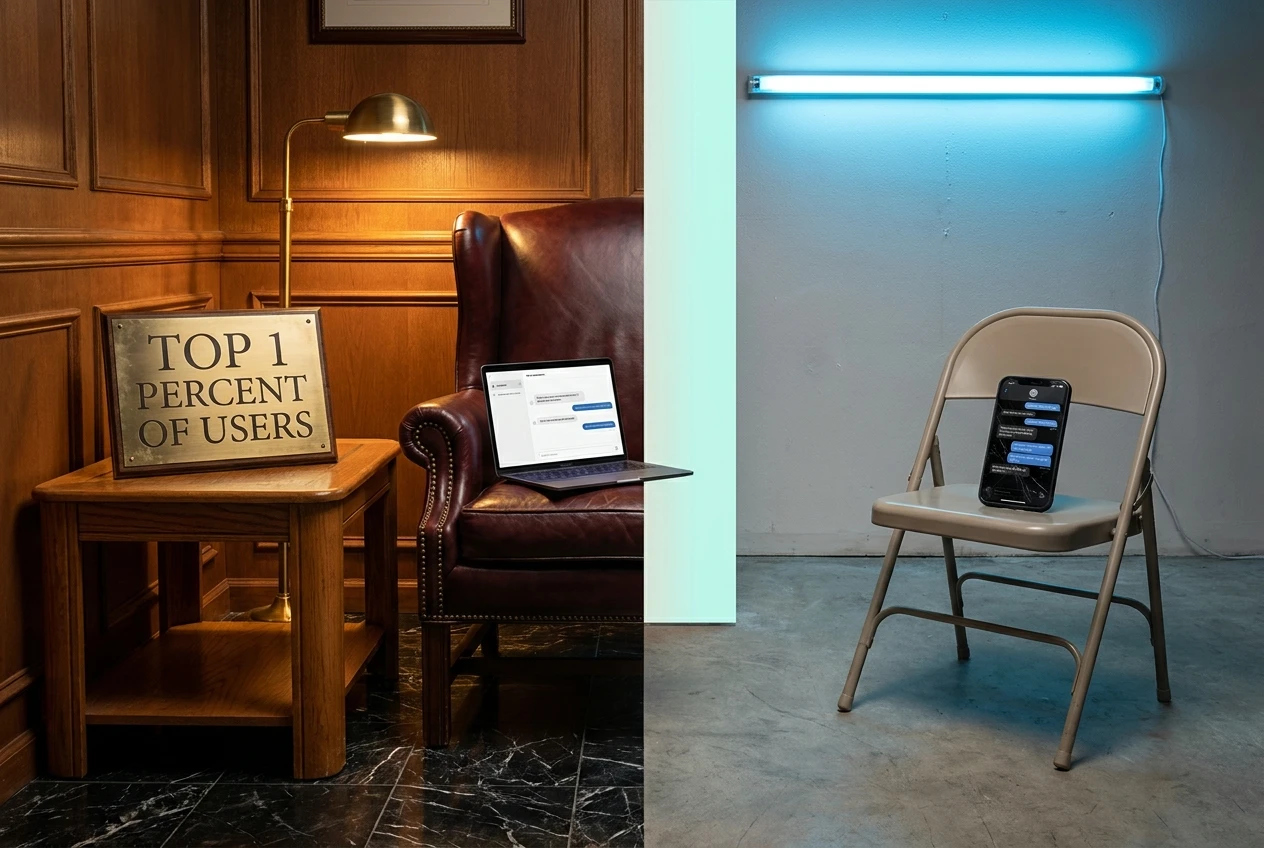
Claude’s Users Skew Wealthy, But Reach Just 6% of US High Earners

Claude has built the most affluent user base of any major AI assistant in the United States, with 80 percent of its weekly users living in households earning more than $100,000 a year, according to Epoch AI’s analysis of three pooled Ipsos KnowledgePanel waves released April 22, 2026. The figure dwarfs Meta AI at 37 percent, tops Microsoft Copilot at 64 percent, and beats ChatGPT, Grok, and Google Gemini at 56 percent each. The number that gets buried under the headline: Claude reaches only 6 percent of US high earners, far behind ChatGPT’s 37 percent.
The skew is real. Claude’s lead in the wealth bracket is a story about who shows up, not who dominates.
The 80 Percent Number, Decoded
Among the 201 Americans who told Ipsos they had used Claude in the prior week, 80 percent reported a household income above $100,000 and only 7 percent reported less than $50,000. The national baseline is 50 percent and 24 percent.
Claude’s user mix runs roughly 30 points ahead of the country in the top bracket and 17 points below it at the bottom. No other major AI service comes close to that asymmetry on either end.
- 80% share of weekly Claude users in $100,000-plus households, per Epoch AI/Ipsos.
- 64% for Microsoft Copilot, the next most affluent service.
- 56% for ChatGPT, Grok, and Google Gemini, clustered tightly together.
- 37% for Meta AI, the only major service below the 50 percent national average.
The authors of the Epoch report, Caroline Falkman Olsson and Jaeho Lee, weighted responses to reflect US adult demographics and excluded 43 invalid responses across the three waves. Sample sizes were near 2,000 in the March 3 to 5 and March 13 to 15 fields, then about 1,000 on April 3 to 5.
Why Claude’s Wealth Lead Is Mostly Symbolic
ChatGPT, not Claude, owns the AI conversation among Americans earning $100,000 or more. The same survey shows 37 percent of high earners use ChatGPT in a typical week, 24 percent use Gemini, 14 percent use Copilot, and 6 percent use Claude.
A larger figure looms over all of those: 44 percent of high earners told Ipsos they used no AI service at all in the past week. The high-income market that Anthropic appears to dominate is, in absolute terms, mostly empty.
Epoch’s authors flagged the contradiction directly. Claude’s lead is “only relative,” Falkman Olsson and Lee wrote, and its reach in absolute terms “remains small.” Anthropic’s consumer product still functions as a niche import among American knowledge workers, not a mass tool for them.
Meta AI Is the Only Real Outlier
Meta AI is the one major assistant whose audience skews lower-income than the country itself. Just 37 percent of its weekly users live in $100,000-plus households, against the 50 percent national rate, while 32 percent earn under $50,000, eight points above the national 24 percent.
That pattern reflects distribution. Meta AI sits inside Facebook, WhatsApp, and Instagram, surfacing answers in chat threads that hundreds of millions of Americans already open daily, free of charge and without a separate sign-up.
Copilot, ChatGPT, Grok, and Gemini all overrepresent affluent users compared with the country, just less starkly than Claude. None of them inverts the curve the way Meta AI does.
The Anthropic Study That Should Worry Everyone Else
A separate Anthropic experiment found that stronger Claude models extract higher prices in marketplace negotiations, even when the items being traded are identical, and the people stuck with weaker agents do not realize they got the worse deal.
The project, called Project Deal, ran in December 2025 with 69 Anthropic employees. Each was given $100 in gift-card budget and a Claude agent to buy and sell items in a Slack-based marketplace. Across more than 500 listed items, the agents struck 186 deals worth more than $4,000.
When the same item went up for sale once through Claude Opus 4.5 and once through the smaller Haiku 4.5, the Opus agent pulled in $3.64 more on average. A lab-grown ruby fetched $65 with Opus and $35 with Haiku. A broken bicycle sold for $65 with Opus and $38 with Haiku.
People on the losing end might not realize they’re worse off.
Anthropic Project Deal report, December 2025
Participants rated the fairness of their deals at 4.05 out of 7 on Opus and 4.06 on Haiku. The price gap was real. The perception of it was not.
Read alongside the Epoch survey, the implication is uncomfortable. The buyers and sellers most likely to be paired with frontier models in agent-to-agent commerce are also the buyers and sellers already living above the $100,000 line.
A $20 Subscription Wall, Decoded
Pricing helps explain the income tilt. Anthropic’s consumer Claude is free at the entry tier, costs $20 a month for Pro, and reaches $200 a month for the Max plan aimed at heavy users. Opus 4.5, Anthropic’s frontier model, costs $15 per million input tokens and $75 per million output tokens through the API.
ChatGPT and Gemini both offer free tiers that include capable models, plus deep integrations into devices, search, and email that lower the cost of casual use to nearly zero. Meta AI demands no subscription at all.
The combination of higher subscription friction and a brand identity built around developer and enterprise use steers Claude toward customers who already bill their AI tools to an employer, a startup, or a six-figure household budget.
What the Survey Cannot Tell Us
The Ipsos KnowledgePanel poll measures who reports using each service in a given week, not how often they use it, what they use it for, or how much they pay. The 201 weekly Claude users in the sample represent a small slice of the survey universe, and the confidence interval around the 80 percent figure is wider than the headline implies.
The data also does not capture business or API usage, which is where Anthropic earns the bulk of its revenue. Anthropic’s enterprise customer base, including Cursor, Notion, and Replit, sits behind corporate billing that consumer surveys cannot see.
Consumer Claude is a niche product for affluent Americans. Anthropic, the company, is something quite different.
Frequently Asked Questions
Why Do Claude’s Users Skew So Wealthy?
Anthropic prices its consumer Claude tiers at $20 to $200 a month, markets the product to developers and knowledge workers, and lacks the free, default-app distribution of ChatGPT, Gemini, or Meta AI. Those signals draw an audience that already pays for productivity software, which in the United States skews high-income.
How Many Americans Use Claude Each Week?
The Epoch AI/Ipsos survey counted 201 weekly Claude users across roughly 5,000 total respondents pooled across three waves between March 3 and April 5, 2026. The implied weekly reach in the US adult population is in the low single digits, against ChatGPT at 31 percent and Gemini at 21 percent.
What Was Anthropic’s Project Deal Experiment?
Project Deal was a December 2025 internal trial in which 69 Anthropic employees gave Claude agents budgets to buy and sell goods in a Slack marketplace. The agents closed 186 transactions worth more than $4,000, and the more capable Opus 4.5 model consistently negotiated higher seller prices and lower buyer prices than the smaller Haiku 4.5.
Does AI Use Vary by Income Across the US?
Yes. The April 2026 Ipsos poll found 50 percent of US adults reported using any AI service in the past week, but the choice of service splits along economic lines: high earners cluster on ChatGPT, Gemini, and Claude, while Meta AI carries a disproportionate share of users earning under $50,000.
When Was the Epoch AI Income Survey Conducted?
Ipsos fielded the survey in three waves on March 3 to 5, March 13 to 15, and April 3 to 5, 2026, through its KnowledgePanel. Epoch AI published the analysis on April 22, 2026.
Anthropic’s own marketplace test points the same direction the income survey already does: capability and access are not evenly distributed across American households, and the gap is hard to see from inside it. The Epoch data lands as Anthropic’s enterprise revenue accelerates and its consumer product remains the smallest of the major five. Whether the company can move down the income curve without giving up its developer-first identity is the open question its next product cycle will answer.

-
 NEWS10 years ago
Samsung Releases Galaxy Note7 TV Ad as Reddit AMA Leaks Specs
-
 NEWS10 years ago
Android 7.0 Nougat Rolls Out To Nexus Devices With New Emoji, Features
-
 FINANCE9 years ago
Cardano Price Surges as ADA Enters the Crypto Top Ten List
-

 AUTO1 month ago
Tesla’s Roadster Is ‘a Few Weeks Away,’ Says Its Chief Designer
-
 NEWS10 years ago
Pre-Order the First Camera Made for Facebook Live Streaming Video
-
 FINANCE12 months ago
Binance Suspends Trading and Withdrawals for a System Upgrade
-
 FINANCE9 years ago
RChain Price Jumps Nearly 150% to a New All-Time High of $2.03
-
 NEWS10 years ago
Google Play App Icons Get Fresh New Look: See the Latest Design Update