
NEWS
BCI Chief Mishra Faces Resignation Push After NALSAR Freeze
After freezing then lifting NALSAR 2026 enrolment, BCI chairman Manan Mishra faces bars, CJP and lawyers demanding he quit a nearly 12-year post.

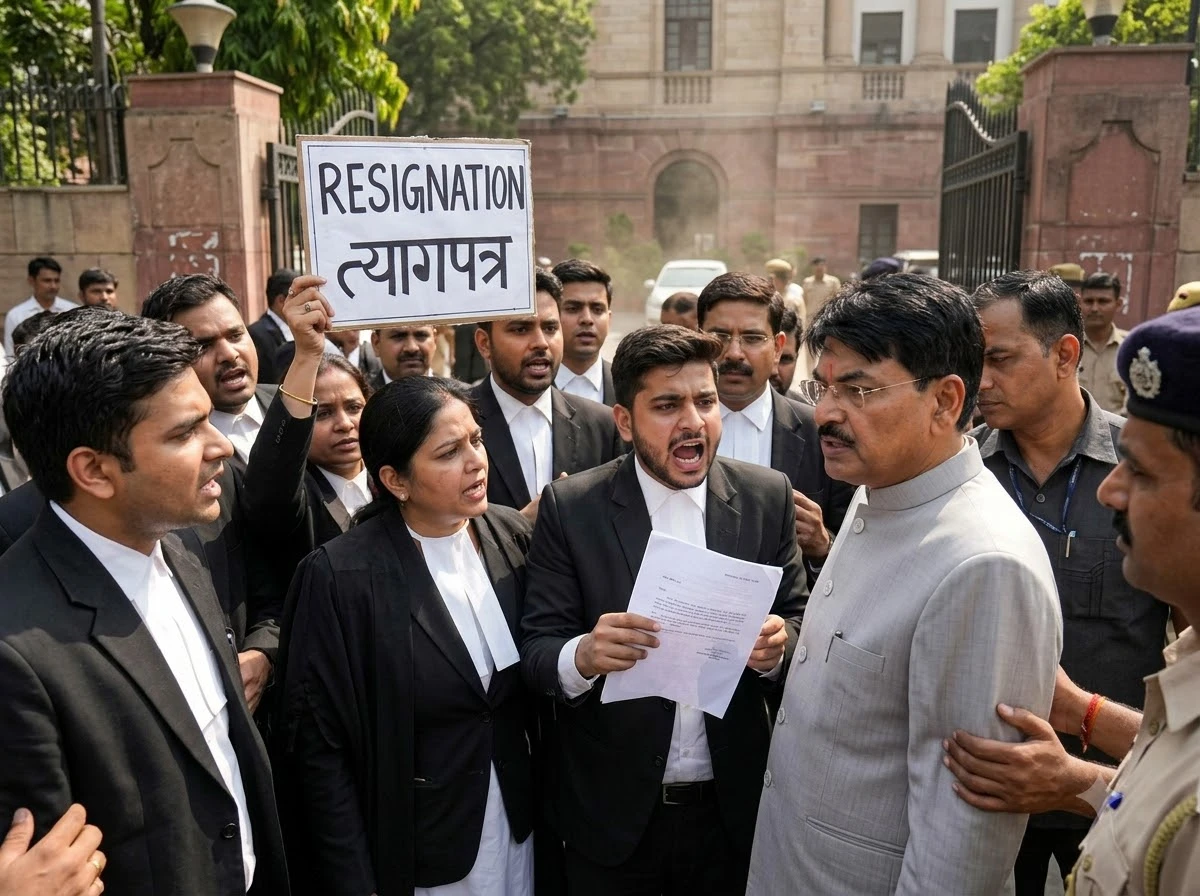
Young advocates gathered outside the Bar Council of India office in New Delhi on Thursday morning demanding the resignation of chairman Manan Kumar Mishra after his short-lived freeze on enrolling NALSAR University of Law’s 2026 graduates. The All India Young Advocates Association led the call; Cockroach Janta Party leaders Abhijeet Dipke, Saurav Das and Ashutosh Ranka backed it within weeks of their successful Jantar Mantar push that forced Union education minister Dharmendra Pradhan out.
What began as student letters objecting to Chief Justice of India Surya Kant as convocation chief guest has become a wider test of how long one man can hold the statutory body that regulates India’s lawyers and law schools. The freeze lasted only hours. The political and institutional fallout has not.
Each step in the chain enlarged the cast. Students wrote. The chairman ordered. Social media and a threat of protest forced a retreat. The Chief Justice rebuked the Council in open court. An apology followed. Bars and collectives then turned a campus dispute into a demand for resignation and fixed tenure.
The Freeze That Lasted Only Hours
On 13 August 2026 a section of outgoing NALSAR students wrote to the vice-chancellor, registrar and faculty opposing any invitation to CJI Surya Kant. They pointed to his recent courtroom remarks on alleged police excesses during NEET-related protests. That evening Mishra, as BCI chairman, directed every state bar council not to enrol any 2026 NALSAR graduate “till further orders.”
The order also sought a factual report identifying students who organised or mobilised the campaign and alleged that some academic staff had misled them. Within hours, after social-media backlash and a public threat of protest from Dipke, the BCI issued a second communication modifying the directions. Enrolment was restored. Proceedings against the entire batch were later closed.
- 13 August evening: BCI chairman directs freeze on NALSAR 2026 enrolments and seeks inquiry into organisers.
- Same night / early 14 August: Order withdrawn after backlash; inquiry language softened then dropped for the batch.
- 14 August: CJI Surya Kant publicly rebukes the BCI intervention in open court.
- 15 August (Independence Day): Mishra issues written apology to students.
- 17-19 August: Lawyers’ collectives and Bombay Bar Association demand resignation.
- 20 August: AIYAA protest outside BCI office backed by CJP.
The sequence left the impression of an impulsive exercise of power followed by an equally rapid retreat. A single evening order had put an entire graduating batch’s careers at risk. The correction came only after public heat made the original course untenable.
That speed mattered. Critics read the freeze as proof that enrolment power could be used as leverage in a dispute that did not concern professional misconduct. The later withdrawal, they argued, could not erase the signal the first order had already sent.
CJI Draws a Clear Line on Student Protest
When the matter was mentioned before a Supreme Court bench headed by CJI Surya Kant on 14 August, the Chief Justice did not mince words. He described the BCI action as “totally uncalled for” and said the Council had “no business” inserting itself into what was “a dialogue between students and me.”
If students have a cause or a reason to protest, they have a right to protest. Nobody can stop them, and we will not allow this. They had no business to interfere.
Chief Justice of India Surya Kant, Supreme Court, 14 August 2026
The bench restrained the BCI and state bar councils from any coercive or criminal action against NALSAR students or faculty over the episode. Kant added that even if students were wrong they retained the right to speak, provided protests stayed lawful and peaceful. The court also asked how the original order had been issued without a full council meeting.
That last question cut to process. The freeze had gone out under the chairman’s authority and reached every state bar council before any full sitting could weigh it. The bench’s restraint order then locked in a shield for the batch and for faculty named in the inquiry language.
In practical terms the court separated three things: the students’ right to object, the Council’s duty not to punish lawful speech, and the unresolved issue of how such a sweeping direction was cleared in the first place.
An Apology That Failed to Close the Chapter
On Independence Day Mishra addressed “my dear young friends” in a letter. He acknowledged that recent developments had caused “concern and anguish” among students and wrote: “If anything connected with the present controversy, any of my words, or letter, has hurt the feelings of our law students, I sincerely regret and apologise for the same.” He stressed that peaceful disagreement and protest are features of constitutional democracy and that no student should feel compelled either to attend or abstain from the convocation.
The apology was welcomed by some as a step toward de-escalation. It did not satisfy the growing list of critics who said the original order itself had already crossed a line that required more than regret.
Timing weakened the letter’s force. It arrived after the court had already called the intervention uncalled for, after enrolment had been restored, and after the batch-wide inquiry language had been dropped. For bars that later wrote to Mishra, regret without resignation looked like damage control rather than accountability.
Bars and Collectives Join the Call
By Sunday three lawyers’ collectives claiming more than 700 members, All India Lawyers Association for Justice, National Alliance for Justice Accountability and Rights, and Queer Lawyers Association, had written to Mishra demanding he resign forthwith. Failing that, they said they would seek a no-confidence resolution from other BCI members. Their statement called his leadership “weak” and said the episode left the fraternity “deeply ashamed.”
The Bombay Bar Association, after its standing committee met on 17 and 18 August, went further. In an 18 August letter it described the 13 August communication as an “abuse” of office issued without hearing the students, causing “grave prejudice” to their careers. It called the subsequent apology “clearly belated” and “nothing but an attempt to assuage the situation,” adding that Mishra “ought to have already resigned.”
| Group | Core Demand | Date |
|---|---|---|
| Three lawyers’ collectives (~700 members) | Immediate resignation; else no-confidence motion | 17 Aug |
| Bombay Bar Association | Resignation; apology insufficient | 18 Aug |
| All India Young Advocates Association | Resignation + fixed tenure for chairman | 20 Aug protest |
| NALSAR Student Bar Council | Apology and condemnation of original letter | Mid-Aug |
A separate writ petition has been filed in the Supreme Court seeking term limits for BCI and state bar council top posts and a review of how the bodies function.
The demands now run on two tracks at once. One is personal: resignation of the present chairman. The other is structural: fixed tenure and a harder look at how the Council exercises enrolment and disciplinary power. The writ petition keeps the second track alive even if street pressure eases.
Nearly 12 Years Without a Fixed Term
The BCI’s own site lists Manan Kumar Mishra as chairman. He first held the post around 2012, returned permanently on 9 November 2014 after a brief intervening term, and has been re-elected unopposed repeatedly, most recently for a seventh consecutive term in March 2025. As of August 2026 that amounts to roughly 11 years and nine months of continuous control.
- Statutory term: BCI rules prescribe a two-year term for chairman and vice-chairman.
- Actual tenure: Continuous since November 2014 through successive unopposed re-elections.
- Side role: Mishra is also a Rajya Sabha MP from Bihar (assumed office August 2024).
- Regulatory reach: BCI exercises powers under the Advocates Act 1961 over enrolment standards, professional conduct and legal education.
Critics on X and in bar circles have long argued that such unbroken tenure concentrates power and blunts accountability. The NALSAR episode supplied a concrete illustration they say can no longer be brushed aside. One recent post by Dipke himself noted the “long 12 years tenure” as reason enough for the chairman to go. Protesters outside the BCI office on Thursday also listed lack of stipends for new advocates and difficulty securing meetings with the chairman as additional grievances.
The gap between the two-year rule on paper and more than a decade in practice is the core of that grievance. Unopposed re-elections turned a short statutory term into continuous control. When the freeze order went out without a full council meeting, opponents treated that fact as the natural product of concentrated authority rather than a one-off lapse.
Legal Cockroaches Gather at the Gate
The All India Young Advocates Association scheduled the 10 a.m. protest for 20 August outside the BCI office. CJP leaders moved quickly into support. Dipke posted “Manan, it’s done bro! All legal cockroaches must join this protest.” Das wrote that “Moral responsibility commands that Manan Kumar Mishra resigns. Cockroaches both inside and outside courts should ensure this happens.” Ratna Singh, CJP legal affairs head, called every peaceful protest “legitimate and welcome” and said demanding accountability is both right and responsibility.
The language deliberately echoes the irreverent brand that helped CJP force Pradhan’s exit weeks earlier. That earlier CJP’s earlier Jantar Mantar campaign showed the group’s ability to sustain pressure and convert online heat into physical presence. Thursday’s gathering featured placards, slogans and police deployment; some reports later said the protest was called off for the moment while pressure continues through other channels.
Beyond the personalities, the episode has revived debate over whether the full text of the Advocates Act still matches the realities of a profession whose regulator has been headed by the same person for more than a decade.
Young advocates at the gate tied the freeze to everyday complaints: no stipends for new entrants, hard access to the chairman, and a sense that enrolment power sits too far from those it binds. The CJP backing gave the AIYAA protest a ready network and a tested method for keeping the story alive after the crowd dispersed.
From Campus Letter to Institutional Stress Test
The original student letter concerned a convocation guest. The BCI response turned that letter into a batch-wide enrolment freeze and an inquiry into organisers and faculty. Court intervention, an apology, bar resolutions and a street protest then stacked on top of one another within a single week.
What the chain exposed was not only a disputed order but a path of escalation available to the chair:
- Enrolment leverage: a direction to every state bar council could halt careers overnight.
- Inquiry threat: seeking names of student organisers and alleging faculty misconduct raised the personal cost of protest.
- Process gap: the court asked how the order issued without a full council meeting.
- Partial reverse: restoration of enrolment and closure of batch proceedings left the tenure question untouched.
Each layer drew in a new audience. Students defended speech. The Chief Justice drew a line on interference. Bars called the apology belated. Young advocates and CJP carried the fight to the BCI gate. The writ petition on term limits moved the same fight into a slower forum.
None of those steps required fresh misconduct findings against any graduate. The stress test was institutional: how far enrolment and inquiry powers can stretch when the same chairman has held them through successive unopposed terms.
Why Resignation Demands Outlast the Freeze
Enrolment is restored. The batch faces no coercive follow-up under the Supreme Court restraint. Mishra’s Independence Day letter expressed regret and restated the place of peaceful protest in constitutional democracy. On the narrow facts of the NALSAR cohort, the emergency is over.
Resignation demands continue because critics separate the cure from the cause. They treat the freeze as evidence of how power is held, not only of how one night’s order was worded. The Bombay Bar Association called the apology an attempt to assuage the situation. The three collectives tied weak leadership to shame across the fraternity. AIYAA added fixed tenure to its resignation call.
| Issue | Present status |
|---|---|
| NALSAR 2026 enrolment | Restored; batch proceedings closed |
| Coercive action vs students or faculty | Restrained by Supreme Court |
| Chairman’s position | No resignation; no announced internal review |
| Tenure rules | Two-year term on paper; continuous hold since 2014 |
| Writ on term limits | Pending in Supreme Court |
That table is why the gate protest and the bar letters still matter after the freeze died. The students won back their immediate rights. The open question is whether the Council will change how long one person may direct it, and under what internal checks.
Mishra has not resigned. The BCI has not announced any internal review of the process that produced the original freeze. Lawyers’ groups say they will keep pressing for both a change at the top and structural limits on future tenures. The students whose letter started the chain have their enrolment rights restored and a Supreme Court shield against retaliation. The larger question of how the Bar Council of India exercises power, and for how long one chairman may hold it, remains open on the table outside its own gate.

-
 TECH1 year ago
Where Garmin Watches are Made and How They are Assembled
-

 AUTO3 months ago
Tesla’s Roadster Is ‘a Few Weeks Away,’ Says Its Chief Designer
-
 NEWS10 years ago
Samsung Releases Galaxy Note7 TV Ad as Reddit AMA Leaks Specs
-
 NEWS10 years ago
Android 7.0 Nougat Rolls Out To Nexus Devices With New Emoji, Features
-
 FINANCE9 years ago
Cardano Price Surges as ADA Enters the Crypto Top Ten List
-
 NEWS10 years ago
Pre-Order the First Camera Made for Facebook Live Streaming Video
-
 FINANCE1 year ago
Binance Suspends Trading and Withdrawals for a System Upgrade
-
 FINANCE9 years ago
RChain Price Jumps Nearly 150% to a New All-Time High of $2.03