
NEWS
SC Panel on NEET Protest Force Reaches Far Beyond July 20
A retired-judge panel will probe excessive force, pellets and women protesters’ complaints from the July CJP marches.

The Supreme Court on Thursday named a five-member High-Powered Expert Committee headed by former judge Justice R Subhash Reddy to examine allegations of excessive force by police and paramilitary units against NEET paper-leak protesters at Jantar Mantar and elsewhere. The same panel will also look at violence directed at security personnel.
Chief Justice Surya Kant and Justices Joymalya Bagchi and V Mohana made clear the enquiry is continuous, with periodic interim findings rather than a single report. Priority goes to harassment and molestation claims by female protesters and to serious injuries.
The Five Who Will Judge the Crackdown
The court chose the members for expertise and diversity. Justice Reddy chairs. The others are former Punjab and Haryana High Court Chief Justice Ravi Shankar Jha, former Delhi High Court judge Justice Shalinder Kaur, former CBI Director Rishi Kumar Shukla and retired Meghalaya DGP L R Bishnoi.
| Member | Prior Role |
|---|---|
| Justice R Subhash Reddy | Former Supreme Court judge (chair) |
| Justice Ravi Shankar Jha | Former Chief Justice, Punjab and Haryana High Court |
| Justice Shalinder Kaur | Former Delhi High Court judge |
| Rishi Kumar Shukla | Former CBI Director |
| L R Bishnoi | Retired Meghalaya DGP |
The bench said the mix of judicial and policing experience would allow a full assessment. Departmental action against officers can proceed on its own; it does not wait for the panel.
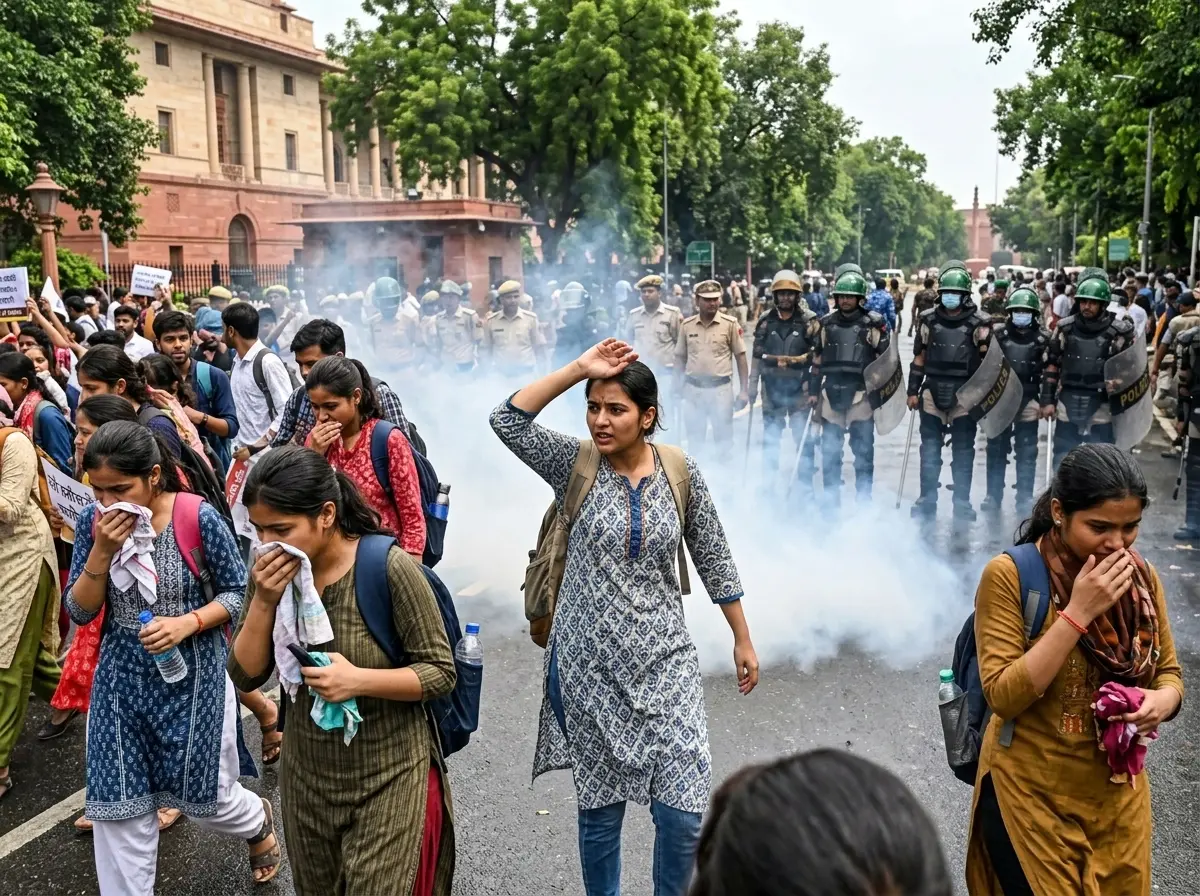
July 20 at Jantar Mantar Left More Than Bruises
Thousands of students and supporters, organised largely by the Cockroach Janta Party, tried to march from Jantar Mantar toward Parliament on the opening day of the Monsoon Session. They demanded Education Minister Dharmendra Pradhan’s resignation over the NEET-UG 2026 paper leak.
Police and RAF units used tear gas, batons and, according to multiple accounts, metallic pellets from pump-action weapons. Clashes followed. Hospital sources and organisers put protester injuries above 100; one CJP tally reached about 150 hospitalised and 70 detained. Delhi Police reported 118 personnel hurt and 15-20 vehicles damaged. Ram Manohar Lohia Hospital logged 65 medico-legal cases by evening.
- Protester injuries: hospital and CJP figures of 60 to 150, including broken bones and pellet wounds to face and eye
- Police injuries: official claim of 118 personnel
- Specific case: 19-year-old Sahil Lochab treated for pellet injury to the eye
- Detentions: dozens of minors ordered released except those facing grave charges
Footage of a DCP slapping a woman protester circulated widely and entered High Court litigation. Gurdwara Bangla Sahib sheltered students fleeing the gas. The court has ordered all CCTV, drone, body-cam and PCR records preserved so the sequence cannot be altered.
Pellets, Nameplates and the Rules Under Review
The terms of reference go well past assigning blame for one afternoon. The committee must consider whether metallic pellets fired from pump-action rifles should be banned given the permanent injuries they cause. It will weigh a requirement that officers wear clear nameplates and identifiable uniforms during crowd control so individuals can be held to account.
Surveillance of protesters will be checked against privacy and assembly rights. The larger task is to define a workable balance between keeping public order and the constitutional right to peaceful protest.
Earlier in the same batch of cases the court declined a blanket ban on pellet guns. It noted that existing regulations allow them in exceptional situations as part of graded force. Petitioners pointed to UN less-lethal guidelines and the absence of pellets from the Bureau of Police Research and Development crowd-control SOP. The bench told challengers they would have to attack the underlying rules themselves if they want decommissioning. It did direct the Centre to preserve RAF ammunition logs from the July deployment.
Pellet guns first introduced in Kashmir in 2010 after lethal live-fire deaths, and their use has remained contested ever since for eye injuries and deaths. The Delhi episode brings that debate into the heart of the capital against a largely student crowd.
Female Protesters Get First Priority
The order singles out allegations of harassment and molestation of women. Online victimisation through social media is also inside the panel’s brief. The court has already barred police from making protesters’ private data public.
These directions sit alongside the earlier release of detained minors. The focus reflects the composition of the July crowds, which included large numbers of young women, and the viral videos that made individual incidents national news within hours.
How a CJI Remark Became a National Sit-In
The movement that filled Jantar Mantar began as online satire. In May, Chief Justice Surya Kant compared certain unemployed youth and social-media activists to cockroaches and parasites. Digital strategist Abhijeet Dipke launched the Cockroach Janta Party as a direct response. What started as a joke became a sustained sit-in after the NEET paper was cancelled over leak allegations and CBSE marking irregularities piled on.
Climate activist Sonam Wangchuk joined on 28 June and began a hunger strike that lasted 26 days. Opposition parties, student federations and eventually large Gen Z crowds turned the site into a continuous presence. On 20 July the Sansad Chalo attempt produced the clashes now under enquiry. Pradhan resigned on 25 July. The government offered assurances on future paper-leak prevention and compensation for families of students who died by suicide. The street campaign wound down the same day.
The full timeline of the Jantar Mantar sit-in shows how quickly a digital jab became the sharpest recent challenge to examination administration. Parallel unrest appeared in Bihar and other states, including one reported use of an AK-47 by a policeman.
Student anger over exam integrity is not confined to NEET. Similar student exam protests in Jharkhand have drawn political support on the same theme of fairness and accountability.
Both Sides of the Force Question
Solicitor General Tushar Mehta told the court police had identified more than 2,800 people with prior heinous offences among those who turned violent. Organisers and opposition MPs countered that the bulk of the crowd was peaceful students and that force was disproportionate from the start. The panel is explicitly told to examine protester violence and injuries to security personnel as well as police excesses.
That dual mandate is already shaping early reaction. Some voices welcome an independent look at both claims. Others worry the “both sides” framing could blur clear video evidence of lathi blows and pellet rounds against unarmed marchers. The continuous nature of the enquiry, with interim reports, gives the court tools to correct course if one narrative begins to dominate.
- 6 June 2026: CJP street presence begins at Jantar Mantar after NEET cancellation.
- 28 June 2026: Sonam Wangchuk starts indefinite hunger strike.
- 20 July 2026: Sansad Chalo march met with tear gas, batons and reported pellets; injuries on both sides.
- 23-25 July 2026: Wangchuk ends fast; Pradhan resigns; protests called off after government assurances.
- 18-20 August 2026: Supreme Court hearings culminate in HPEC constitution and evidence-preservation orders.
Parliament’s Monsoon Session itself was repeatedly disrupted by opposition demands for accountability over the crackdown, keeping the issue alive well after the tents came down.
The Panel Keeps Working After the Cameras Leave
The court has already protected evidence and personal data. It has freed most detained minors. Departmental proceedings against officers can start without waiting. What remains is the slower work of recommendations on weapons policy, identification rules and the practical line between lawful assembly and unlawful crowding.
Because the committee must report periodically rather than once, pressure will stay on both police leadership and protest organisers. Any finding on metallic pellets or mandatory nameplates will travel far beyond Delhi. Future student marches, farmers’ sit-ins or urban demonstrations will operate under whatever standards this panel helps set.
The July resignation already delivered the protesters’ main political demand. The judicial sequel is about whether the methods used to contain them become the new normal or the last example of an old approach.

-
 TECH1 year ago
Where Garmin Watches are Made and How They are Assembled
-
 AUTO3 months ago
Tesla’s Roadster Is ‘a Few Weeks Away,’ Says Its Chief Designer
-
 NEWS10 years ago
Samsung Releases Galaxy Note7 TV Ad as Reddit AMA Leaks Specs
-
 NEWS10 years ago
Android 7.0 Nougat Rolls Out To Nexus Devices With New Emoji, Features
-
 FINANCE9 years ago
Cardano Price Surges as ADA Enters the Crypto Top Ten List
-
 NEWS10 years ago
Pre-Order the First Camera Made for Facebook Live Streaming Video
-
 FINANCE1 year ago
Binance Suspends Trading and Withdrawals for a System Upgrade
-
 FINANCE9 years ago
RChain Price Jumps Nearly 150% to a New All-Time High of $2.03