BUSINESS
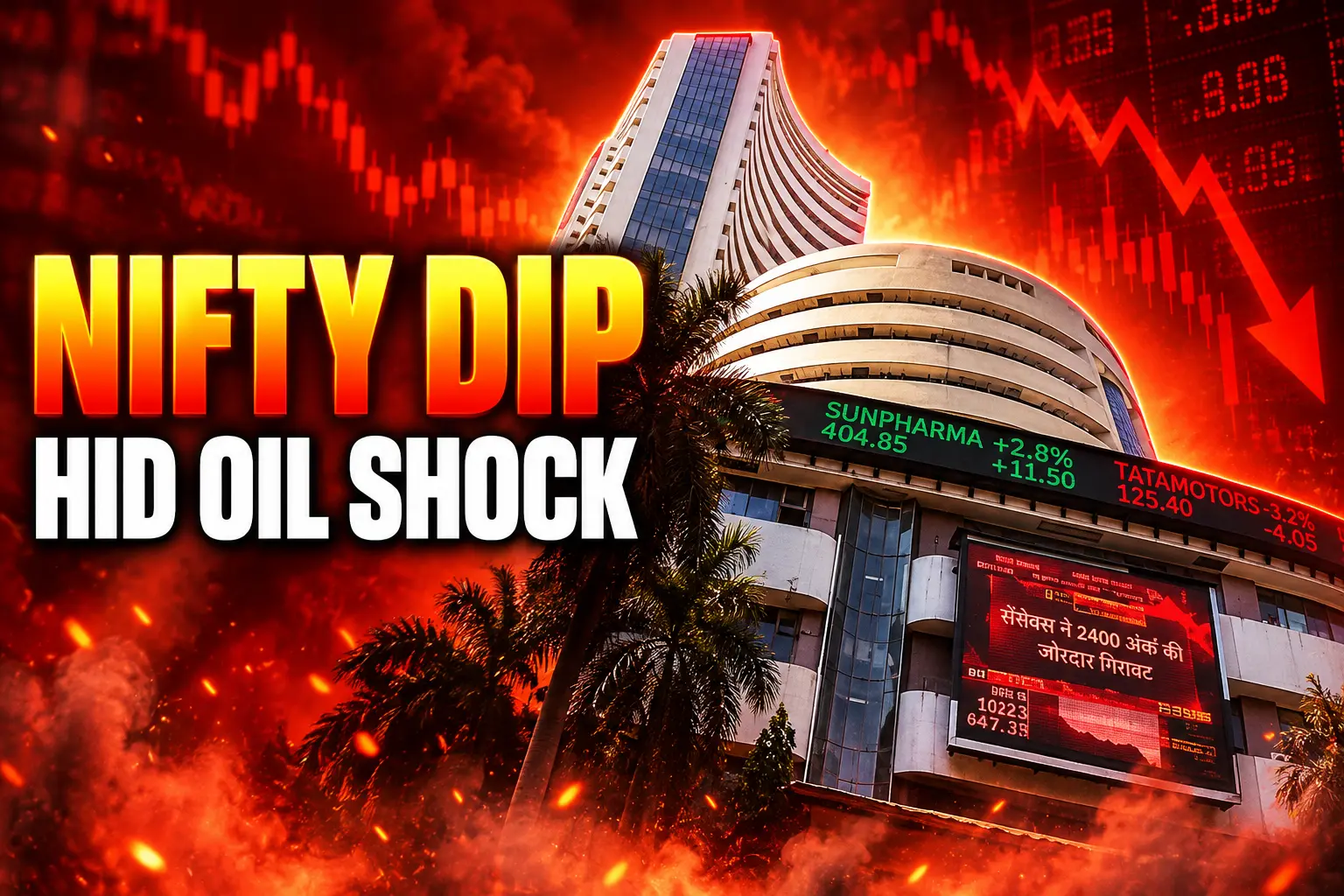
The Nifty Dip Hid Oil Shock and an ITC Deal
The Nifty 50 slipped 0.10% on Tuesday as Brent jumped and ITC rallied on a merger, then Wednesday’s oil spike punched through 24,000.

The Nifty 50 fell 0.10% to 24,055.80 on Tuesday, a one-month low printed after the closing auction pulled the index back above 24,000.
The 24.60-point dip was the headline. Under it, Maruti Suzuki sank 4.70%, Shriram Finance lost 5.05%, Brent jumped $3.57, and ITC rallied 4.23% on an IT merger that Happiest Minds shareholders sold hard.
Nifty Held 24,000 After Slipping to 23,952
The cash market opened almost flat, pushed the Nifty to 24,143.15 in the first hour, then sold off into 23,952.55 as crude and financials gave way. Weekly options expiry made the tape choppy, and the closing auction was what put 24,000 back on the board. The Sensex echoed it, finishing at 76,944.28, down 12.99 points or 0.02%, after an intraday run from 77,231.87 to 76,656.12.
TUESDAY’S BENCHMARKS
| Index | Close | Change | Intraday range |
|---|---|---|---|
| Nifty 50 | 24,055.80 | -24.60 (-0.10%) | 24,143.15 / 23,952.55 |
| Sensex | 76,944.28 | -12.99 (-0.02%) | 77,231.87 / 76,656.12 |
| Nifty Bank | 57,409.60 | -615.35 (-1.06%) | – |
Bank Nifty’s 1.06% drop was the tell the headline indices hid. Nifty IT rose 0.98% and Nifty FMCG 0.94%, enough to hold the 50-stock average while banks, autos and healthcare went the other way. India VIX only climbed 1.16% to 11.32, a quiet print for a session that already had oil, a one-month Nifty low and a 5% hole in Shriram Finance.
That low-vol close is why 24,000 looked saved. It was not a calm book. It was a handful of heavyweights offsetting a much wider tape, with the auction doing the last bit of work after 3:15 p.m.
Brent’s $4 Jump Hit Autos and Airlines First
December Brent rose 4.04%, or $3.57, to $91.94 a barrel, its largest gain since July 24, as the United States and Iran traded strikes around the Strait of Hormuz. October West Texas Intermediate added 2.27%, or $1.95, to $87.71. Aviation turbine fuel in India was marked 5.46% higher, and InterGlobe Aviation, which runs IndiGo, was among the Nifty’s weaker names, down about 4% in the cash session.
Kpler, the commodity data firm, has already treated a partial closure of the Strait of Hormuz as the base case for the rest of 2026, cutting Middle East supply enough to flip its second-half balance from a 1.5 million barrel-a-day surplus to a deficit of nearly 2 million. Chinese refiners, running 18% below year-ago intake, are the reason the barrel has not gone further. India does not get that buffer. It imports the crude, and the auto and airline stocks traded that fact on Tuesday, hours before Wall Street’s next down-leg and before Brent pushed through $95 overnight.
The rupee still closed at a two-month high of 94.95 per dollar, from 95.16 on Monday, and gold for December delivery fell 1.06%, or $47.34, to $4,434.16. Dollar index futures inched up 0.15% to 99.54. A stronger rupee on an oil up-day is the odd print in the set, and it did not protect Maruti, the Nifty Auto basket, or the banks.
Anuj Singhal, a market editor posting before Wednesday’s open, laid out the global book as Brent at $95-plus, the U.S. 10-year near 4.8%, the Dow off 0.8% and the Nikkei near -2.2%. Financials, metals and high-beta names were the ones he flagged as exposed. That is the tape India actually got on Wednesday, after Tuesday had only priced the first slice of it.
Why Maruti Dropped After Selling 219,220 Cars
Maruti Suzuki India, the Nifty’s largest automaker, closed at ₹12,910, down ₹637 or 4.70%, the session’s loudest blue-chip loss. August sales were not a collapse. Total dispatches were 219,220 units, up 21.3% from 180,683 a year earlier, and the company said it had already crossed 1 million units in the first five months of FY27.
What the stock sold is the sequential step-down from July’s 241,421 units, a shortfall of 22,201, plus exports that fell 7.4% to 33,844 from 36,538 as West Asia shipping stayed tight. Sales to other OEMs, mostly small cars for Toyota Kirloskar, dropped 48% to 5,298. Domestic passenger vehicles still rose 34.8% to 176,971 from 131,278, with utility vehicles up 46.3% to 79,045.
MARUTI’S AUGUST SALES
- Total units: 219,220, including 180,078 domestic, 5,298 to other makers and 33,844 exported.
- Passenger vehicles: 176,971 at home, with cars at 85,965 and utility vehicles at 79,045.
- April-August: 1,143,365 units, up 28.6% from 889,070 a year earlier.
- Backlog: 1.8 lakh bookings, and SUV share at 36% of the portfolio versus 12% five years ago.
Partho Banerjee, Maruti’s senior executive officer for sales and marketing, was still talking about a production ramp and a festive pipeline, not a demand hole. The industry, he said, looked like about 4.5 lakh passenger vehicles in August, and he kept a 10% growth call for FY27 after an earlier 4% to 6% band. Factory plans still include ₹77,500 crore of capex from FY27 through FY31.
We witnessed growth in every segment. The recent ramp-up in production is helping. We have a booking backlog of 1.8 lakh vehicles. Our SUV share in our entire portfolio has gone up to 36% from 12% five years ago.
Partho Banerjee, Senior Executive Officer, Sales and Marketing, Maruti Suzuki India
Hyundai Motor India MD and CEO Tarun Garg separately blamed August export slippage on West Asia logistics, the same constraint sitting in Maruti’s 33,844 export print. Bajaj Auto still rose nearly 2% on a stronger month, so this was not a uniform auto wipeout. It was Maruti, a Nifty heavyweight, being marked down for a sequential fade, an export leak, and a crude tape that makes every future fuel-cost print harder.
Happiest Minds Sold a 22% Stake and the Shares Sank
ITC was the Nifty’s best stock, up 4.23%, or ₹10.80, to ₹266.30, because its IT subsidiary moved on Happiest Minds after the close on Monday. signed definitive agreements on August 31 is the Happiest Minds version of the same event: a promoter sale, then a merger, then a listing of ITC Infotech.
Happiest Minds fell as much as 12.2% as that structure hit the screen. The cash is real and the wait is long, and the market priced those as two different stocks.
The Cash Tranches and the Share Swap
ITC Infotech’s August 31 exchange filing says the board approved a purchase of 3,36,61,700 Happiest Minds shares, 22.106% fully diluted, from Ashok Soota and Ashok Soota Medical Research LLP, plus an amalgamation into ITC Infotech. The cash is about ₹1,330 crore (about $140 million), funded by a rights issue at ITC Infotech, in two tranches: 11% at ₹390 a share and 11.106% at ₹400. Surviving Happiest Minds holders get 25 ITC Infotech shares of face value ₹10 for every 81 Happiest Minds shares of face value ₹2. ITC Limited is slated to hold about 73.4% of the merged company, which the two firms want listed on BSE and NSE.
THE ITC INFOTECH DEAL
- Scale target: $1 billion of revenue by FY28 on a pro forma basis, with more than 19,000 staff and 800-plus clients in over 30 countries.
- FY26 base: combined revenue of ₹7,033 crore, from Happiest Minds’ ₹2,315.11 crore and ITC Infotech’s ₹4,718 crore.
- Clock: CCI, exchanges and the NCLT still to clear the scheme, with completion expected in about 15 months.
- Tuesday add-on: a PwC and Grant Thornton valuation puts the listed combo around ₹18,000 crore, with ITC Infotech at ₹12,000 crore and Happiest Minds at ₹6,167 crore.
Ashok Soota, chairman and chief mentor at Happiest Minds, treated the deal as a home for the firm inside a larger IT shop. Karan Uppal, lead IT analyst at PhillipCapital, went the other way on the listed stub, pointing at a 12-to-18-month approval slog and a leadership question after the merger.
I am delighted that after the completion of legal formalities, Happiest Minds will become an important part of a larger organization through its amalgamation with ITC Infotech.
Ashok Soota, Chairman and Chief Mentor, Happiest Minds Technologies, in ITC’s media statement
That split, ITC up 4.23% and Happiest Minds down double digits, is the other half of Tuesday’s “flat” Nifty. Adani Ports added 3.45% to ₹1,648.00 and Bharti Airtel 3.10% to ₹1,868.00, while HCL Technologies rose 3.21% to ₹1,351.00 and Infosys 2.44% to ₹1,154.00 on the Sensex. The money that left Maruti and the financiers did not leave the building. It went into the deal stock, telco and IT.
Midcaps, Banks, and the Breadth Count
Falling stocks beat rising ones by 1,613 to 979 on the NSE, with 55 unchanged, and by 2,372 to 1,672 on the BSE, with 187 unchanged. Nifty Midcap 100 lost 1.39%, Nifty Midcap 50 1.31% and Nifty Next 50 1.20%. Nifty 500 was off 0.47% and Nifty Smallcap 100 only 0.23%. The damage sat in the middle of the market, not in the smallest names and not in the Nifty close.
SECTOR SCOREBOARD, SEPTEMBER 1
| Basket | Move | Basket | Move |
|---|---|---|---|
| Nifty IT | +0.98% | Nifty Healthcare | -1.60% |
| Nifty FMCG | +0.94% | Nifty Pharma | -1.45% |
| Nifty Oil and Gas | +0.35% | Nifty Realty | -1.42% |
| Nifty Media | +0.26% | Nifty Consumer Durables | -1.40% |
| Nifty Auto | -1.22% | ||
| Nifty PSU Bank | -1.21% |
Shriram Finance closed at ₹1,053.90, down ₹56.00 or 5.05%, without a fresh quarterly miss on the day. The stock moved with Nifty Bank and Nifty PSU Bank, on a tape already digesting higher crude and a three-week grind in the Sensex. Nestle India fell 4.01% to ₹1,436.50 and slipped through the ₹1,450 zone even as the FMCG index itself finished higher, because ITC’s deal pop was doing that index’s work. State Bank of India lost 2.51% to ₹1,033.40 and Bajaj Finserv 2.40% to ₹1,970.00.
Foreign funds had just dumped ₹7,985.88 crore on August 31, the heaviest day of that month, during the first MSCI rebalance since the closing-auction regime. Provisional exchange data had them as net buyers on Tuesday, with domestic funds also buying. That bid, plus ITC, Airtel and IT, is how a 1.4% midcap loss becomes a 0.10% Nifty loss. India’s April-June GDP print of 7.8% was already on the table from August 31. Growth was not the thing the cash market was marking.
Oil Finished on Wednesday What Tuesday Started
Shrikant Chouhan, head of equity research at Kotak Securities, had spent Tuesday night treating 24,000 and 23,950 as the supports that mattered, with 24,100 to 24,150 as the first ceiling. Rupak De at LKP Securities said a hold above 23,950 could still produce a bounce, and that 24,200 was resistance. Both notes assumed the Tuesday close was a floor. Overnight oil did not read those notes.
THE THREE SESSIONS THAT BROKE 24,000
- August 31, 2026: ITC Infotech and Happiest Minds sign the stake-and-merger papers; the GDP print of 7.8% for April-June is already out; FIIs sell ₹7,985.88 crore.
- September 1, 2026: Nifty swings from 24,143.15 to 23,952.55 and closes 24,055.80 after the auction; Brent’s December contract settles $91.94; Maruti and Shriram take 4% to 5% hits.
- September 2, 2026: Fresh U.S.-Iran strikes push Brent toward $96; around 9:23 a.m. IST the Nifty is at 23,803.10, down 1.05%, the Sensex at 76,188.87, down 755 points, and Nifty Auto at 27,912.35, down 2.03%.
Dip-buy calendars that needed a close above 24,000 were still technically right on Tuesday night. They were wrong by Wednesday’s open, which is the complaint that ran through the trading chat after the gap: the stop was taken on the overnight crude jump, not on the 24,055.80 print. By late morning the auto complex was still being sold even after a 36% year-on-year jump in August car sales to 448,319 units, because the oil number had overwritten the volume number.
Tuesday’s 0.10% close was the lag. Wednesday morning, with Brent near $96 and the Nifty near 23,800, was the session that finally caught up with the barrel.
Disclaimer: This article is news reporting and analysis of market moves, company filings and commodity prices, and it is for information only. It is not investment advice, a research recommendation, or an offer to buy or sell any security, derivative or commodity, and it does not consider any reader’s objectives, risk limit or tax position. Anyone acting on figures in this piece should first consult a SEBI-registered investment adviser or another qualified financial professional who can review their own holdings. Index levels, stock prices, oil quotes, currency prints and deal terms are those published by the sources as of 2 September 2026 and can change in the next session.

Eiffel Tower Managers Hid Women for a Guru’s Visit

Russia Ends the Kyiv Pause With Missiles After Envoys Leave

Putin Meets Modi With Jets and Reactors Under a Tariff Cloud

iOS 27 Folds Pro Camera Tools Into the Default App

Adobe Bets on Its Experience Cloud Chief as CEO

The iPhone 18 Pro Max Splits Apple’s Fall in Two

OpenAI Calls GPT-6 Astra AGI Then Locks Its Exploits

Trump Claims Hormuz Control as Oil Holds Near $96

Russia Closes the Goethe-Institut Berlin Tried to Save

Volkswagen’s Job Cuts Leave Four Plants Without Cars

 NEWS2 weeks ago
The iPhone 18 Pro Max Splits Apple’s Fall in Two
- NEWS1 week ago
OpenAI Calls GPT-6 Astra AGI Then Locks Its Exploits
- BUSINESS2 weeks ago
Trump Claims Hormuz Control as Oil Holds Near $96
- LIFESTYLE1 week ago
Russia Closes the Goethe-Institut Berlin Tried to Save
- AUTO1 week ago
Volkswagen’s Job Cuts Leave Four Plants Without Cars
- NEWS2 weeks ago
Samsung Splits Galaxy Book6 With a $799 Core 3 Twin
- BUSINESS1 week ago
Cable Stocks Fall as UltraTech Copies the Paints Playbook
- BUSINESS2 weeks ago
Japan’s 3 Percent Yield Reprices Government Debt Worldwide