BUSINESS
Subhash Chandra’s Majority Vote Still Produced No NCLT Order
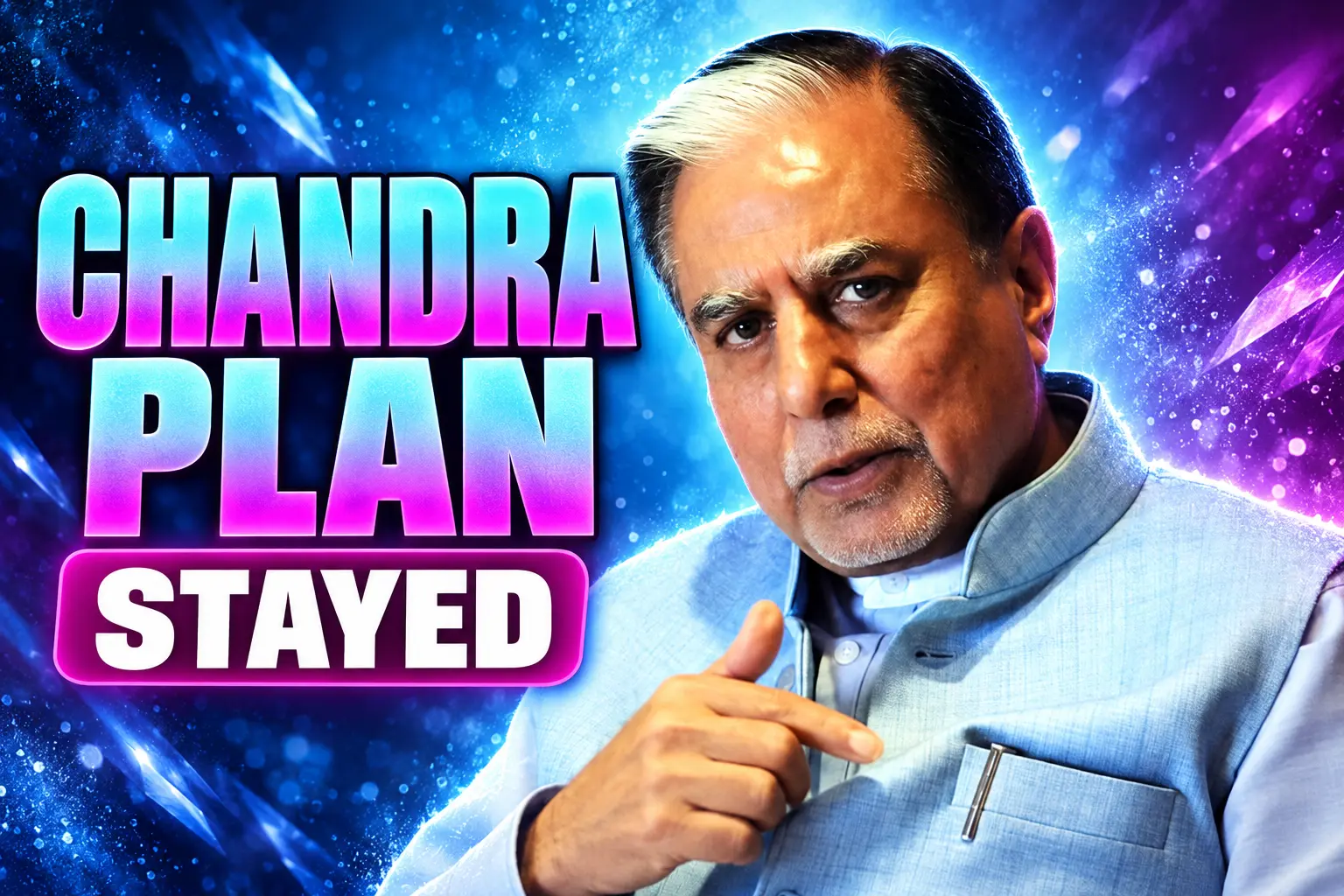
Subhash Chandra’s plan won 80.814% creditor support, then three NCLT members wrote three orders, and a five-member bench stayed it.

A five-member NCLT bench on Tuesday stayed Subhash Chandra’s ₹6.25 crore repayment plan against ₹22,006.57 crore in admitted claims. The stay follows a finding that three members wrote three different legal results, so no majority order exists.
The same bench, headed by President Justice Anupinder Singh Grewal, also barred the Essel Group founder from alienating property, directly or indirectly. Solicitor General Tushar Mehta, appearing for creditors, had asked for that restraint. Notices went out, and the tribunal said it would hear every party at length.
Three Judges and Three Legal Endings
The public row treated the 25 August opinion of Judicial Member Nilesh Sharma as a final NCLT clearance. The original two-member bench, six days later, said it was not. Sharma had been brought in after a 3 September 2025 split. When his opinion came back, Judicial Member Ashok Kumar Bhardwaj and Technical Member Reena Sinha Puri compared all three writings and held that no majority view had emerged.
THE CASE CLOCK
- 22 April 2024: The Delhi bench admits Indiabulls Housing Finance’s Section 95 petition against Chandra as a personal guarantor.
- 1 November 2024: Voting on the repayment plan closes at 12:01 pm with 80.814% of votes cast in favour.
- 3 September 2025: Bhardwaj and Puri split, and the difference goes to the NCLT president under Section 419(5) of the Companies Act.
- 25 August 2026: Sharma, the third member appointed in February, favours approval under Section 114 and applies Section 115 to every creditor.
- 31 August 2026: The original bench records that no majority view has emerged and that no order can be passed at this stage.
- 1 September 2026: A five-member special bench stays Sharma’s opinion and bars alienation of property.
The clock matters because the Code’s “commercial wisdom” rule only works if the tribunal can turn a creditor vote into one operative order. Here the vote was clear and the legal effect was not.
THE THREE OPINIONS ON THE PLAN
| Member | View on the plan | What happens to dissenters |
|---|---|---|
| Reena Sinha Puri, Technical | Reject | Creditors may move for bankruptcy |
| Ashok Kumar Bhardwaj, Judicial | Approve | Dissenters keep independent recovery rights |
| Nilesh Sharma, Third Member | Approve | Section 115 binds assenting and dissenting creditors alike |
Puri’s opinion attacked the makeup of the creditor body, alleged associate voting, the resolution professional’s checks, asset disclosure, and the lack of a hard, unconditional payout. Bhardwaj would have let LIC Housing Finance, HDFC Bank, Canara Bank, Union Bank of India and others pursue recovery outside the plan. Sharma said the Code does not allow that split. The original bench treated Sharma’s writing as an independent order, not a concurrence on the point that had to be decided. “No majority view has emerged in the matter,” it recorded, and “No order can be passed at this stage.”
Banks Held 18.42% of the Vote
The plan cleared the three-fourths mark because 80.814% of the votes actually cast were in favour. That figure is easy to misread. Of the full voting share, 77.48% voted yes, 18.42% voted no, and 4.10% did not vote. Once the abstentions drop out, the yes camp is 80.814% of votes cast. Ten creditors voted yes, seven voted no, and six entries did not vote.
HOW THE LARGE VOTES FELL
| Creditor | Voting share | Vote |
|---|---|---|
| World Crest Advisors | 28.49% | For |
| Lemonade Capital Advisors LLP | 16.85% | For |
| Catalyst Trusteeship (CINDA FPI) | 11.85% | For |
| Corpcall Capital Advisors LLP | 10.30% | For |
| LIC Housing Finance | 6.09% | Against |
| Veena Investments Private Limited | 4.99% | For |
| IDBI Trusteeship (Franklin Templeton) | 3.36% | Against |
| HDFC Bank | 3.17% | Against |
Axis Bank (2.86%), Canara Bank (1.60%), Union Bank of India (UK) Ltd (0.76%) and RBL Bank (0.55%) also voted against. The five largest yes votes, World Crest through Veena, added up to 72.48% of the total voting share. Objecting lenders told the tribunal that five of those names, Veena Investments, Direct Media Distribution Ventures, World Crest, Lemonade and Corpcall, were associates and should have been locked out. Together those five held 61.78%. Sharma held that the objectors had not proved the statutory test of an “associate,” including the more-than-50% ownership or board-control limb. HDFC Bank had pointed to a SEBI interim order; the defence noted that the Securities Appellate Tribunal had quashed the underlying findings.
Indiabulls Housing Finance, the petitioner that started the case and is now Sammaan Capital, voted for the plan with a 1.98% share. Direct Media (1.15%), Kautilya Traders (1.02%), Anil Kumar (0.67%) and Sunil Jain (0.18%) completed the yes list. Among those who sat out were IDBI Trusteeship for an Edelweiss fund (2.60%) and IndusInd Bank (1.11%).
What Section 115 Would Do to Dissenting Lenders
The fork that killed the majority is a short clause. Once a tribunal approves a repayment plan under Section 114 of the Code, Section 115 says what that approval does to people who voted no.
Where the Adjudicating Authority has approved the repayment plan under section 114, such repayment plan shall take effect as if proposed by the debtor in the meeting and be binding on creditors mentioned in the repayment plan and the debtor.
Section 115(1), Insolvency and Bankruptcy Code, 2016
Sharma read that text as all-or-nothing. An approved plan, he held, is binding on creditors in the plan, whether they voted yes or no. Letting dissenters sue for the full original debt would, in his view, undo the vote and treat creditors unequally. Bhardwaj had written the opposite protection into his directions. If Sharma’s reading ever becomes the majority, LIC Housing Finance’s ₹1,322.39 crore admitted claim, against a proposed ₹38.09 lakh (about 0.028%), is bound by the plan. If Bhardwaj’s reading wins, the banks keep a second shot at Chandra and at the principal borrowers. If Puri wins, the plan dies and bankruptcy is the next filing.
LIC Housing Finance has already said the personal-guarantor case does not wash out the corporate loans or its mortgages. HDFC Bank said its admitted claim was only 3.2% of the stated total, a book it inherited from HDFC Ltd, and that it had voted against the plan. Canara Bank said it had demanded a forensic audit and could not get one on a minority vote. Those positions only bite if Section 115 does not close the door.
The Forensic Audit Creditors Asked For Never Happened
Canara Bank’s application recorded a 2018 net-worth certificate at ₹40,562 crore. A 2017 certificate put the figure at ₹45,888 crore. The resolution professional’s present disclosed net worth was about ₹31.79 crore. Union Bank, in written submissions, pointed to assets of about ₹39 crore in Chandra’s Rajya Sabha nomination papers. He sat in the Upper House from 2016 to 2022 as an Independent backed by the BJP. Sharma accepted that the drop gave creditors a fair reason to ask questions. He also held that the Code does not make a forensic audit a mandatory step before a plan can be approved, and that the gap alone did not prove concealment.
Chandra had, at the first meeting of creditors on 18 September 2024, consented to an independent asset finder or forensic auditor. Objecting banks say that offer was never taken up. The IBBI’s personal guarantor repayment plan rules ask for the source of funds, a minimum family budget, and a rule that at least 10% of realisable income go to debts. They do not, on their face, force a forensic sweep of a promoter’s historic wealth.
WHAT DISSENTING LENDERS PUT ON THE RECORD
- Forensic audit: Canara Bank and others wanted an independent auditor and an asset-tracing agency to test how net worth fell from the 2018 certificate to the present disclosure.
- Associate votes: HDFC Bank, IDBI Trusteeship and others sought to drop five creditors holding 61.78%, arguing they were associates under Section 109(4)(b) and Section 79(2).
- Bulk claims: Sharma did exclude claims filed through Anil Kumar and Sunil Jain for 960 and 300 people, 1,260 names in all, and told the RP to spread that slice among remaining eligible creditors.
- Uncertain extra cash: The 2025 opinions recorded about ₹1,494 crore supposedly coming from principal borrowers; objectors said that money was not assured inside the personal plan.
The plan on the table is ₹6.25 crore for creditors and ₹25 lakh for process costs, ₹6.5 crore in all, a recovery of about 0.028% and the 99.97% haircut that filled the week’s headlines. Sharma’s view was that bankruptcy, on a depleted personal estate, would not pay more. Assenting creditors made the same point: the group companies stay on the hook even if the guarantor’s plan is approved.
The Case Started With a ₹170 Crore Guarantee
The caption is still CP(IB)-97/(ND)/2022, Indiabulls Housing Finance Ltd vs Dr Subhash Chandra. An RP was first named on 30 May 2022. Supreme Court litigation on the personal-guarantor chapters then paused the field. Admission came on 22 April 2024. The spark was a ₹170 crore facility to Vivek Infracon, with Chandra as personal guarantor, which turned bad. Shiv Nandan Sharma later replaced the first RP and filed IA-5505/2024 seeking approval under Section 114.
Chandra’s office has been blunt about the denominator. “There is no personal borrowing by Dr Subhash Chandra from any of the creditors named in the order or from any other creditor/lender. He only signed personal guarantees,” the office said. It put the objectors’ claims in the personal-insolvency case at ₹3,992 crore, not ₹22,006.57 crore. He has also said the entities whose loans he backed have repaid ₹43,000 crore of ₹45,000 crore. On 30 August he said those borrowers had assured him they would reconcile accounts and clear an outstanding ₹4,262 crore. The personal case is separate from insolvency of group companies and from regulatory proceedings around Zee Entertainment Enterprises.
In 2025 the Technical Member recorded 25 creditors, two treated as ineligible, and claims of the remaining 23 at about ₹21,697 crore. The later ₹22,006.57 crore figure is the one LIC Housing Finance used before Sharma. Both numbers are claims against a guarantor, not a personal loan book in his own name. That distinction did not slow the political heat. It also does not decide Section 115.
IBBI Data Shows 1% Recovery From Guarantors
The haircut looks unique until it is set beside the personal-guarantor chapter as a whole. IBBI figures as of June 2026 show 64 approved repayment plans, with creditors recovering ₹234.56 crore, about 1% of admitted claims, across 2,137 cases where a resolution professional had been appointed. At the end of March the same series showed 44 plans, ₹102.78 crore, and 2.16%. More claims entered the June quarter, and the recovery rate fell even as rupees recovered rose.
TWO RECOVERY BOOKS
- Personal guarantors, June 2026: 64 closed repayment plans, ₹234.56 crore recovered, about 1% of admitted claims, 2,137 cases with an RP.
- Corporate CIRP, to June 2026: IBBI records ₹4.35 lakh crore in CIRP recoveries against claims of ₹14.27 lakh crore, 166.58% of liquidation value and 94.72% of fair value.
- This plan’s personal estate: ₹6.25 crore against ₹22,006.57 crore of admitted guarantor claims, about 0.028%.
- Chandra’s own comparator: objectors’ claims, per his office, ₹3,992 crore; group-level repayments, per Chandra, ₹43,000 crore of ₹45,000 crore.
Corporate insolvency still returns a large share of the value of the assets in the company. Personal-guarantor insolvency returns about a rupee on a hundred of the guarantee claims that get this far. Chandra’s proposed 0.028% is thinner than that 1% average, which is why the banks that hold 18.42% have gone to the appellate tribunal. It is also why a yes vote dominated by private creditors could clear 75% and still leave the tribunal unable to finish the sentence.
Chandra Tells NCLAT the Larger Bench Has No Power
On Wednesday, a day after the stay, Chandra’s counsel told the National Company Law Appellate Tribunal that Section 419(5) is a narrow difference-of-opinion clause and does not authorise a five-member NCLT bench. “The scope of Section 419(5) is very limited. It does not give power to the NCLT under the IBC or company law to form a five-member bench,” the counsel argued. The same lawyers called the lenders’ appeals defective because they attack an order that never became a majority decision.
Mehta, still for the lenders, asked NCLAT to keep those appeals alive so the banks can revive them once the five-member bench finishes. The appellate tribunal did not kill the appeals and posted the matter for 7 October. If lenders want to attack Tuesday’s stay itself, they were told they must file a separate appeal. The five-member NCLT bench, which also includes Judicial Members Bachu Venkat Balaram Das and Mahendra Khandelwal and Technical Members Atul Chaturvedi and Ravindra Chaturvedi, listed its own next hearing for 23 September. Grewal’s bench has already said, in line with the 31 August finding, that there is no “clear majority view capable of being given effect to,” and that Sharma’s 25 August opinion is stayed.
A week is a short interval in which to assemble five members, and that speed is being read in public as a reaction to the 99.97% haircut rather than to the 31 August majority failure. The oral order on property was not shy. “We also direct that the guarantors shall not alienate the properties whatsoever either directly or indirectly,” the bench said. Until 23 September, that bar, not the ₹6.25 crore, is the only operative line in the file.
Disclaimer: This article is news reporting and analysis of tribunal proceedings under the Insolvency and Bankruptcy Code. It is informational only and is not legal advice, insolvency advice, or a view on any security, loan, guarantee or claim. Readers with a stake in these proceedings, or in any similar guarantee, should consult a qualified insolvency lawyer or chartered accountant before acting. Figures, vote shares, hearing dates and the status of the repayment plan reflect the orders and statements cited as of 2 September 2026 and may change at the hearings listed for 23 September and 7 October.

Eiffel Tower Managers Hid Women for a Guru’s Visit

Russia Ends the Kyiv Pause With Missiles After Envoys Leave

Putin Meets Modi With Jets and Reactors Under a Tariff Cloud

iOS 27 Folds Pro Camera Tools Into the Default App

Adobe Bets on Its Experience Cloud Chief as CEO

The iPhone 18 Pro Max Splits Apple’s Fall in Two

OpenAI Calls GPT-6 Astra AGI Then Locks Its Exploits

Trump Claims Hormuz Control as Oil Holds Near $96

Russia Closes the Goethe-Institut Berlin Tried to Save

Volkswagen’s Job Cuts Leave Four Plants Without Cars

 NEWS2 weeks ago
The iPhone 18 Pro Max Splits Apple’s Fall in Two
- NEWS1 week ago
OpenAI Calls GPT-6 Astra AGI Then Locks Its Exploits
- BUSINESS2 weeks ago
Trump Claims Hormuz Control as Oil Holds Near $96
- LIFESTYLE2 weeks ago
Russia Closes the Goethe-Institut Berlin Tried to Save
- AUTO1 week ago
Volkswagen’s Job Cuts Leave Four Plants Without Cars
- NEWS2 weeks ago
Samsung Splits Galaxy Book6 With a $799 Core 3 Twin
- BUSINESS2 weeks ago
Japan’s 3 Percent Yield Reprices Government Debt Worldwide
- BUSINESS2 weeks ago
India Inc’s 2026 Exits Leave the Hard Jobs Open