
BUSINESS
Tata Sons AGM fails for first time as trust freeze blocks quorum
Tata Sons postponed its 108th AGM after Sir Ratan Tata Trust could not nominate a joint representative under a Charity Commissioner ban.

Tata Sons adjourned its 108th annual general meeting on August 18 after 30 minutes when the required quorum failed to materialise, the first such halt in the holding company’s history. Sir Ratan Tata Trust could not field a joint representative with Sir Dorabji Tata Trust because of a continuing freeze ordered by Maharashtra’s Charity Commissioner.
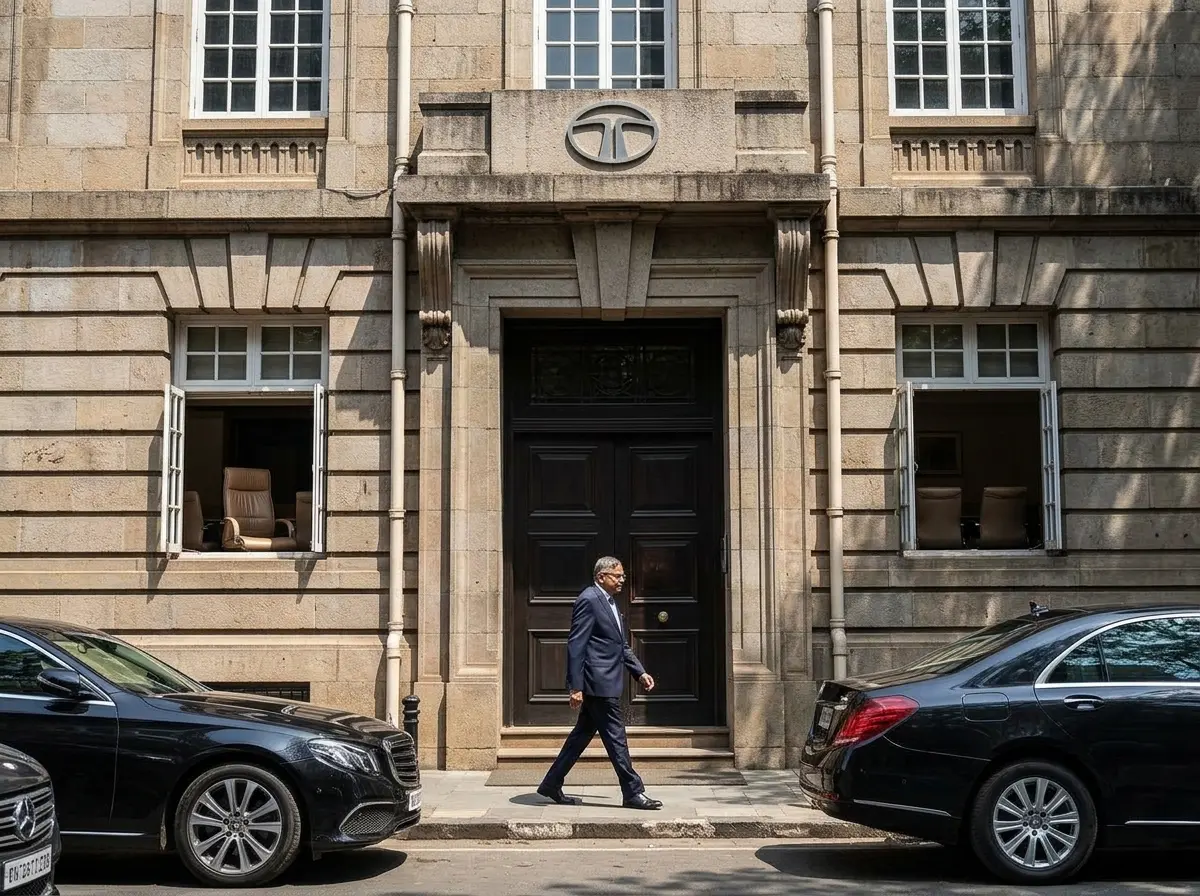
N. Chandrasekaran arrived at Bombay House for the 2:30 p.m. session; Noel Tata joined by video. Proceedings stopped short of adopting accounts, declaring a dividend or renewing Chandrasekaran’s directorship.
The halt was procedural on its face and structural in its effect. Without the joint nominee the articles demand, the room could not lawfully open ordinary business. That single missing authorisation turned a scheduled formality into an open pause that now stretches across accounts, payout and board renewal at once.
How the quorum rule stopped the meeting cold
Article 86 of Tata Sons’ articles of association demands at least five members personally present. One of them must be an authorised representative jointly nominated by Sir Dorabji Tata Trust and Sir Ratan Tata Trust whenever the pair together hold 40 percent or more of the equity. They hold more than that.
SRTT, with its 23.56 percent stake, has been barred since May from convening board meetings while the Charity Commissioner investigates complaints over lifetime trustees and governance under the Maharashtra Public Trusts Act. Without a trustees’ meeting, SRTT could not join SDTT in naming the required nominee. SDTT made clear it would not act alone.
| Shareholder | Stake | Role in quorum |
|---|---|---|
| Sir Dorabji Tata Trust | 27.98% | Joint nominee required with SRTT |
| Sir Ratan Tata Trust | 23.56% | Blocked from nominating under freeze |
| Other Tata Trusts | ~14.5% | Part of overall 66% trust holding |
| Total philanthropic trusts | 66% | Control stake in Tata Sons |
The arithmetic is simple and unforgiving. SDTT and SRTT together clear the 40 percent threshold that triggers the joint-nominee rule. Other trusts and shareholders can fill ordinary seats in the room, yet none of them can supply the specific joint authorisation Article 86 reserves for those two.
The board is expected to meet in coming weeks to fix a fresh date once SRTT obtains relief to hold its own internal meeting. Until that relief arrives, the same gap will confront any reconvened session.
What sat on the agenda that never opened
The official AGM notice listing the three ordinary items set out straightforward business dated June 12.
- Adoption of audited standalone and consolidated financial statements for the year ended March 31, 2026
- Declaration of dividend on ordinary shares for FY 2025-26
- Re-appointment of N. Chandrasekaran as a director liable to retire by rotation
Chandrasekaran remains a director until a valid AGM can act. His term as executive chairman runs to February 20, 2027; he has already said he will not seek another term after that date.
None of the three items is exotic. Adoption of accounts is the annual housekeeping step every holding company expects to clear. The dividend resolution is the cash bridge from Tata Sons to the trusts that own it. The director vote is the ordinary rotation mechanism that keeps the board current. All three now wait on the same missing nominee.
Because the meeting never opened, no vote was recorded and no resolution carried. The notice itself remains valid as a statement of intended business; only the date of action has slipped.
The May freeze that reached August
The Charity Commissioner ordered SRTT in May to defer meetings and face an inspector-level inquiry after complaints alleging that lifetime trustees exceeded the 25 percent board limit under Section 30A of the state trusts act. Formal hearings have not begun. Officials say a report could take weeks or months.
- May 2026: Charity Commissioner freezes SRTT board meetings pending inquiry into trustee composition and related complaints.
- June-July 2026: Trusts lawyers seek temporary relief ahead of key meetings; requests unheard.
- August 12, 2026: Chandrasekaran announces he will not offer himself for reappointment as chairman after February 2027, citing six months of unresolved board differences.
- August 18, 2026: Tata Sons AGM adjourns for want of the joint trusts nominee.
Multiple other matters involving SDTT, Bai Hirabai Jamsetji Tata Navsari Charitable Institution and Navajbai Ratan Tata Trust also sit pending at the same office, including challenges around trustee changes and an old share transfer.
The May order did not name Tata Sons or rewrite its articles. Its practical reach arrived later, when SRTT’s inability to convene blocked the joint nomination the holding company needs for a quorate AGM. A charity-law freeze on one trust thus became a corporate-law obstacle for the group’s parent.
Lawyers for the trusts sought interim room to act before the August date. Those requests went unheard, so the freeze remained intact on the day members gathered at Bombay House.
Dividend delay hits the trusts that own the group
Tata Trusts collectively hold 66 percent of Tata Sons equity held by philanthropic trusts. Dividends from Tata Sons fund large parts of their education, health and livelihood programmes. The adjournment leaves that payout in limbo until a fresh meeting can declare it.
The same trusts that control the holding company now find one of their own unable to complete the paperwork needed to keep the machine running. That circular bind is the second-order cost of the regulatory freeze.
Until a valid AGM declares the dividend, the cash stays inside Tata Sons. Programme budgets that assume an ordinary-year payout must wait on the Charity Commissioner’s pace and on SRTT’s recovery of the power to nominate. Ownership and beneficiary status have collided: the trusts own the company that pays them, yet one trust’s freeze now delays the payment path for all.
Chandrasekaran’s board seat and the longer fight
The AGM notice was issued before Chandrasekaran’s August 12 statement. He told the board he would not press for another five-year chairmanship after a February meeting failed to secure unanimous support. One director withheld backing; reports widely identified that director as Noel Tata, who chairs Tata Trusts.
Differences had run for months over strategy, possible listing of Tata Sons, board composition and an exit path for the Shapoorji Pallonji stake. An earlier pattern of Trusts friction around Chandrasekaran resurfaced once Ratan Tata’s era ended. A selection committee for the next chairman is already forming under the trusts.
Until the AGM can sit, Chandrasekaran continues as director. The leadership transition clock keeps ticking toward February 2027 with no formal successor named.
The director renewal on the August agenda was always a narrower question than the chairmanship. Rotation keeps him on the board; the chairmanship term is a separate clock ending in February 2027. The adjournment freezes only the first of those tracks. The second continues, and the trusts’ selection work for a successor proceeds against that fixed date.
First adjournment in 108 years lands in a succession window
Corporate observers long treated Tata Sons AGMs as routine affairs decided by prior consensus. This was the first time the meeting could not even begin. On X, reaction mixed procedural surprise with sharper takes on control: one widely viewed thread framed the empty nominee seat as the visible edge of a deeper contest over who steers the group after the professional chairman’s planned exit.
The adjournment itself changes little overnight. It does lock the accounts, the dividend and the director renewal in place while the Charity Commissioner’s inquiry continues and the trusts sort their internal nomination.
Timing magnifies the symbolism. The halt landed six days after Chandrasekaran said he would not seek another term, and months into public discussion of strategy, listing and the Shapoorji Pallonji exit path. A process long viewed as ceremonial has become a live checkpoint in a succession window that already has a February 2027 end date.
Two Trusts Must Nominate as One
Article 86 does not ask SRTT or SDTT to appear as ordinary members. It asks them to appear as a pair whenever their combined holding stands at or above 40 percent. Their stakes of 27.98 percent and 23.56 percent put them well clear of that line, so the joint-nominee duty is mandatory, not optional.
SDTT’s refusal to act alone follows the text of the articles. A solo nomination would not satisfy the joint requirement, and a meeting that proceeded on that basis would risk a defective quorum. The safer course, and the one taken, was to stop.
- Combined SDTT and SRTT holding: above the 40 percent trigger in Article 86
- Instrument required: one authorised representative named jointly by both trusts
- Blocking condition: SRTT freeze prevents its trustees from meeting to approve a joint name
- Result on August 18: five-member personal presence rule unmet; AGM adjourned
Other Tata trusts hold roughly 14.5 percent and form part of the wider 66 percent philanthropic block. They can attend and vote on ordinary business once a meeting is open. They cannot cure the specific joint-nomination gap that belongs to SDTT and SRTT alone.
The design concentrates a gatekeeping role in the two largest trusts. When both can meet, the gate opens as a matter of course. When one cannot, the gate stays shut even if every other shareholder is ready.
The Holding Company Runs While Its AGM Waits
Day-to-day operations at Tata Sons do not depend on the August meeting having opened. The adjournment freezes shareholder resolutions, not commercial management. Accounts remain unaudited only in the AGM sense; the underlying books and the group’s operating companies continue on their ordinary cycles.
What does wait is the formal chain that links ownership to cash and board tenure:
| Item locked by adjournment | Why it waits | What continues anyway |
|---|---|---|
| Adoption of FY 2025-26 accounts | Needs ordinary resolution at a quorate AGM | Internal reporting and subsidiary audits |
| Dividend on ordinary shares | Declaration requires AGM approval | Group trading and cash generation |
| Chandrasekaran director renewal | Rotation vote belongs to the AGM | His existing director status and chair term to February 2027 |
The distinction matters for readers who equate an adjourned AGM with a stalled company. The $185 billion turnover and $277 billion market capitalisation figures reported at the end of March describe a group still trading. The pause is legal and ownership-side, not an operating shutdown.
Still, the ownership side is not cosmetic. Trusts that fund education, health and livelihood programmes rely on the dividend path. Board composition relies on the rotation path. Both paths run through the same AGM door, and that door stays closed until the joint nominee can be named.
What the board and the commissioner decide next
Tata Sons directors will choose a new AGM date once SRTT can meet and nominate. Trustees have already pressed the Charity Commissioner for limited permission to participate in shareholder actions. The probe’s pace will dictate how long the freeze lasts.
Two clocks now run in parallel. One is the commissioner’s inquiry into trustee composition under the Maharashtra Public Trusts Act, with no formal hearings yet and a report that could take weeks or months. The other is the holding company’s need for a fresh AGM date before accounts, dividend and director rotation can move.
Limited permission to join shareholder actions, if granted, would let SRTT complete the joint nomination without fully lifting the wider freeze on its board meetings. That narrower relief is the path trustees have already sought. Full clearance of the inquiry would restore ordinary trust governance and remove the obstacle at its root.
In the meantime the holding company of a group whose turnover exceeded $185 billion and market capitalisation stood at $277 billion at the end of March operates with its annual shareholder meeting suspended and its chairmanship succession still open. The joint nominee required by Article 86 remains the single missing piece that turned a scheduled formality into an open pause.

-
 TECH1 year ago
Where Garmin Watches are Made and How They are Assembled
-
 AUTO3 months ago
Tesla’s Roadster Is ‘a Few Weeks Away,’ Says Its Chief Designer
-
 NEWS10 years ago
Samsung Releases Galaxy Note7 TV Ad as Reddit AMA Leaks Specs
-
 NEWS10 years ago
Android 7.0 Nougat Rolls Out To Nexus Devices With New Emoji, Features
-
 FINANCE9 years ago
Cardano Price Surges as ADA Enters the Crypto Top Ten List
-
 NEWS10 years ago
Pre-Order the First Camera Made for Facebook Live Streaming Video
-
 FINANCE1 year ago
Binance Suspends Trading and Withdrawals for a System Upgrade
-
 FINANCE9 years ago
RChain Price Jumps Nearly 150% to a New All-Time High of $2.03