
NEWS
Kolkata Hotel Fire Kills Nine After Tarapith Blaze Exposes Old Lapses
Nine die from smoke in Mirza Ghalib multi-hotel building two days after Tarapith, as officials cite short circuits.

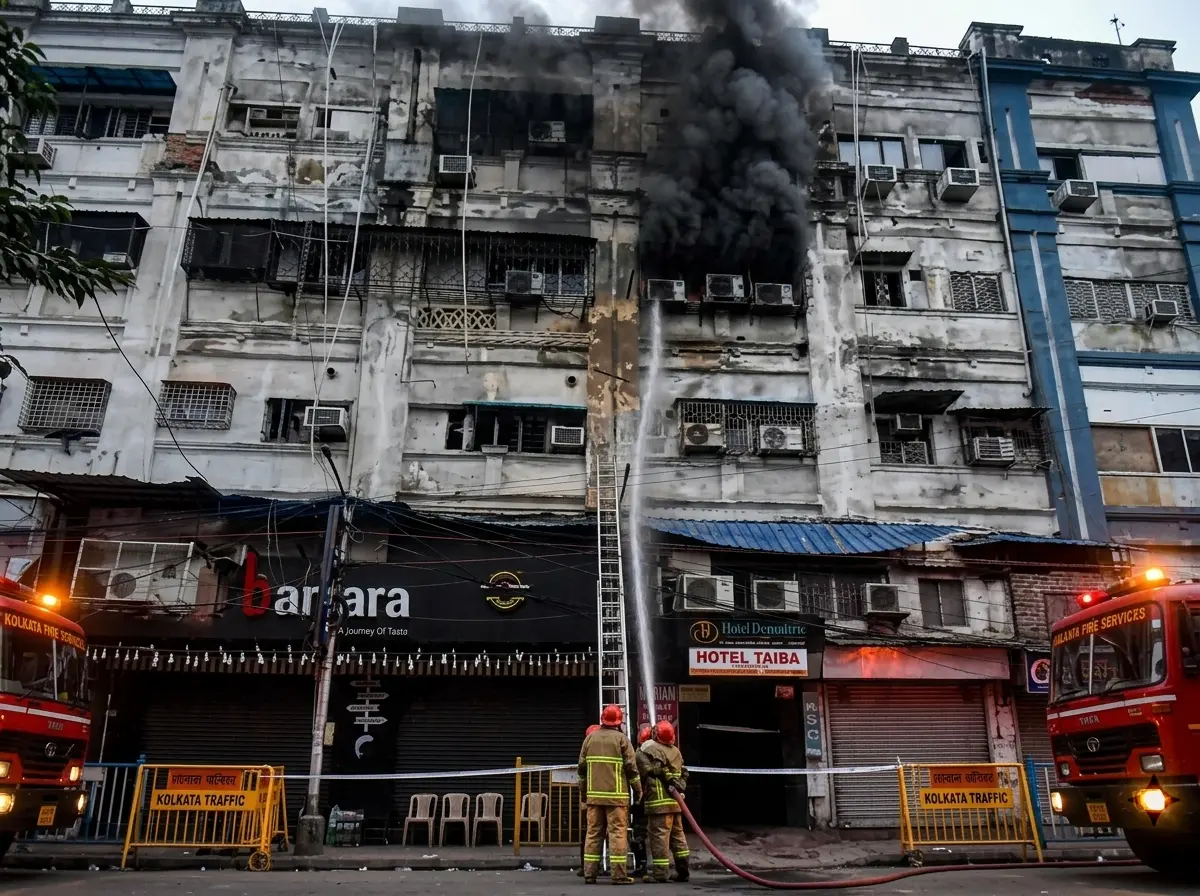
Nine people, including a four-year-old child, died of smoke inhalation in a five-storey multi-hotel building on Mirza Ghalib Street in central Kolkata early on August 19, 2026, while six others were injured. The blaze at Hotel Shikhali started around 1:45 a.m. to 2 a.m. Firefighters rescued around 80 people as dense smoke blocked staircases.
Police registered a case against the absconding owner at New Market police station. An SIT is probing the cause. The deaths came two days after a fire killed nine at Hotel Bideshini in Tarapith.
What Firefighters Found at Dawn
Five fire tenders reached the congested central Kolkata site. Police and disaster management teams joined the rescue. The injured went to Calcutta Medical College. The fire is under control, though the building remained extremely hot during cooling.
- 9 dead, including a child and two women, mostly from suffocation
- 6 injured under treatment
- ~80 rescued from the five-storey structure
- Possible short circuit or air-conditioner blast under forensic review
A police officer told PTI the dense smoke made it difficult for firefighters to climb the staircase and reach the upper floors. More deaths were initially feared. Bodies showed few burn marks. Residents said the fire intensity stayed low while black smoke filled the complex.
Cooling work continued after the flames were brought under control because residual heat made the upper floors unsafe to reenter. The same staircases that trapped guests also slowed the teams carrying the injured down. That bottleneck shaped both the death toll and the early fear that the count would climb higher.
Ten Hotels Stacked in One Building
Each floor of the dingy building housed a hotel or guest house with extremely small rooms and narrow passages. Fire Minister Kaushik Chowdhury visited and said he was shocked. “There are several hotels inside this building. I am shocked to see what was going on here,” Chowdhury told PTI. He noted the building management did not comply with basic safety and construction norms and alleged several irregularities.
The fire began on the third floor. Smoke spread through poor ventilation. Guests could not find exits in the darkness and haze. West Bengal Fire and Emergency Services headquarters sits nearby.
| Observed condition | Required under rules |
|---|---|
| Narrow passages, small rooms | Adequate exits and clear egress paths |
| Poor or failed ventilation | Functional smoke control and vents |
| Multiple hotels per floor | Proper occupancy separation and NOC |
| Suspected short circuit origin | Maintained electrical systems, alarms |
West Bengal Minister Tapas Roy said teams would inspect hotels lacking licences and facilities, with a zero-tolerance approach in congested areas. Agnimitra Paul noted ten hotels running across three floors of a single building with small rooms “cannot be allowed.”
Stacking multiple guest houses on successive floors multiplies the number of people who must share the same stair core when an alarm fails or never sounds. Small rooms and narrow passages leave little space for a second route once the primary path fills with smoke. The minister’s remarks after the visit framed those layout choices as a compliance failure, not an unavoidable feature of low-cost lodging.
Smoke Killed Faster Than Flames
A state fire services official said the nine bodies had few burn injuries. Other residents reported the fire intensity inside was not high. Thick black smoke covered the entire complex and caused severe breathing problems. That points to severe lapses in ventilation facilities.
A city police officer confirmed the fire first broke out in a hotel on the third floor. Smoke gradually increased until the whole building was covered. Residents could not figure out which way to get out. Preliminary reports also mentioned a possible air-conditioner blast, though forensic teams will decide.
When heat remains moderate but smoke becomes total, survival turns on whether vents and exits still function. Here the haze rose through shared shafts and passages faster than guests could orient themselves. The pattern matches the injuries reported at the scene: breathing failure first, burns secondary or absent.
Tarapith Blaze Two Days Earlier
The Kolkata fire followed an almost identical pattern at a pilgrim hotel.
- August 17, 2026, ~4:30 a.m. Fire erupts on the ground floor of four-storey Hotel Bideshini near Tarapith temple and police station in Birbhum district.
- Cause Electrical short circuit. False ceilings and fibre panelling helped the spread. Electric supply cut, rear exit hard to find in dark.
- Deaths Eight to nine pilgrims, five from Garo Hills of Meghalaya and three from Alipurduar. Several injured. Owner Kalyan Paul and son arrested. Hotel claimed an exit existed and no safety loopholes.
- Aftermath At least 15 hotels in the area sealed for protocol violations.
Both incidents hit budget lodging used by travellers from outside West Bengal during peak seasons. Both produced mostly smoke deaths in multi-storey buildings with limited exits.
| Point of comparison | Hotel Bideshini, Tarapith | Hotel Shikhali, Kolkata |
|---|---|---|
| Date and hour | August 17, ~4:30 a.m. | August 19, ~1:45-2 a.m. |
| Building scale | Four-storey pilgrim hotel | Five-storey multi-hotel block |
| Suspected trigger | Electrical short circuit | Short circuit or AC blast (forensic review) |
| How death occurred | Smoke in limited-exit layout | Smoke inhalation, few burn marks |
| Immediate enforcement | Owner and son arrested; 15 hotels sealed | Case against absconding owner; SIT formed |
The two blazes arrived within forty-eight hours and struck the same class of property: dense, low-cost rooms serving visitors who do not know the building well. In both places darkness and blocked or hard-to-find exits turned a containable fire into a mass casualty event driven by smoke.
Budget Lodges for Medical Visitors
Police initially identified all the deceased as Bangladeshi nationals who had come to Kolkata for medical treatment. Fire Minister Chowdhury later said the dead included both Indians and Bangladeshis and identities were still being established. The area around New Market and Mirza Ghalib Street has long served as a hub of budget hotels, lodges and eateries for Bangladeshi patients.
- Kolkata has historically received the largest share of Bangladeshi medical travellers to India.
- Part of the New Market zone is known locally for restaurants, hotels and lodges catering to that traffic.
- Hospitals reported fluctuating footfall after political changes in Bangladesh, with some recovery in recent months.
- Patients often stay in low-cost multi-hotel buildings near transport and treatment centres.
Research on the corridor notes that Kolkata draws most Bangladeshi medical patients, supporting a dense network of affordable stays. Those same dense, low-margin properties repeatedly appear in fire reports.
Medical visitors and their companions often choose rooms within walking distance of clinics and transport nodes. That demand sustains the multi-hotel blocks that line Mirza Ghalib Street and the wider New Market belt. When those blocks cut corners on exits and ventilation, the people most exposed are patients already under physical strain and relatives unfamiliar with the floor plan.
How the Two Fires Mirror Each Other
Side by side, the Tarapith and Kolkata cases show the same failure chain rather than two unrelated accidents. An electrical fault is the suspected starting point in both. Combustible finishes or poor compartmentation then let smoke travel. Guests lose the route out because passages are narrow, lighting fails, or a rear exit is hard to locate in the dark.
- Budget multi-storey lodging used by out-of-state or cross-border travellers
- Night-time ignition when most occupants are asleep
- Smoke as the primary killer, with limited burn trauma on the bodies
- Post-fire sealing drives and licence checks that begin only after deaths
Tarapith’s false ceilings and fibre panelling accelerated spread once the short circuit occurred. Kolkata’s stacked hotels and weak ventilation produced the same end state: a building filled with black smoke while flame intensity stayed relatively low. The shared outcome is what links the two scenes more tightly than geography.
Enforcement timelines also match. Arrests and sealing came quickly at Tarapith. Raids on the owner’s residence and an SIT followed in Kolkata. Ministers in both settings promised wider licence sweeps. The sequence after each fire is orderly on paper and late in practice for the people already dead.
What the Fire Rules Already Require
Under the West Bengal Fire Services Act, 1950, hotels listed as high-risk buildings must hold a Fire Safety Certificate. The definition covers hotels, guest houses and dharmasalas of any size. High-rise buildings above 14.5 metres and multi-purpose occupancy also need clearance. Operating without a valid certificate is a cognizable, non-bailable offence. Owners can face fines, sealing and prosecution.
A mandatory Fire NOC for hotels is required before operations. Sample recommendations cover exits, alarms, extinguishers, sprinklers and electrical safety matched to height and occupancy. Past Kolkata hotel fires, including a 2025 blaze that killed 14, showed expired NOCs, blocked exits, walled windows, dead alarms and non-working sprinklers. Enforcement often follows deaths rather than preventing them.
The building management did not comply with basic safety and construction norms. It is alleged that there were several irregularities in the functioning of the hotel.
Fire Department Minister Kaushik Chowdhury said that after inspecting the Mirza Ghalib site. He pointed to a possible short circuit pending forensic confirmation. Police began raids at the owner’s residence. Chief Minister Suvendu Adhikari was expected to visit.
On paper the statute already treats every hotel and guest house as high-risk stock that needs a live certificate before it opens its doors. Multi-purpose occupancy inside one shell triggers the same clearance bar. The gap is not missing law. It is the distance between the certificate file and the narrow passages guests actually use at 2 a.m.
Why Congested Clusters Keep Failing Checks
Mirza Ghalib Street and the Tarapith pilgrim belt share a commercial logic: pack as many low-tariff beds as the plot will hold, as close as possible to the temple, the market, or the hospital gate. That logic produces the exact conditions listed in the observed-versus-required table above. Passages shrink. Ventilation is an afterthought. Several operators share one stair.
Ministers have now promised zero-tolerance inspections in congested zones and checks on hotels that lack licences and basic facilities. Similar language followed earlier fires, including the 2025 Kolkata hotel blaze that killed 14. Temporary sealing removes the worst operators from the street for a period. It does not by itself redesign the buildings that remain.
Forensic teams and the SIT will settle whether a short circuit or an air-conditioner blast lit the third-floor fire. Whatever they name as the spark, the building already supplied the fuel for mass smoke exposure: stacked hotels, small rooms, and no reliable path out once the haze dropped.
License Sweeps After the Fact
West Bengal ministers announced teams to check permits and fire licences across congested hotel clusters. Similar sealing followed Tarapith. The pattern repeats: a fire, public shock at conditions inside multi-hotel blocks, temporary crackdowns, then quiet return to low-cost operation until the next blaze.
For the families of the nine who died on Mirza Ghalib Street, and the nine at Tarapith, the rules on paper arrived too late. Forensic results and the SIT report will name the exact trigger. The layout of small rooms, narrow stairs and shared smoke paths in buildings that house medical and pilgrim guests already matches earlier tragedies.
Sweep teams can padlock doors and demand fresh NOCs. Lasting change depends on whether those certificates track real exits, live alarms, and working vents before the next overnight crowd checks in. Until that link holds, the corridor that serves patients and pilgrims will keep generating the same smoke-filled staircases and the same post-dawn body counts.

-
 TECH1 year ago
Where Garmin Watches are Made and How They are Assembled
-

 AUTO3 months ago
Tesla’s Roadster Is ‘a Few Weeks Away,’ Says Its Chief Designer
-
 NEWS10 years ago
Samsung Releases Galaxy Note7 TV Ad as Reddit AMA Leaks Specs
-
 NEWS10 years ago
Android 7.0 Nougat Rolls Out To Nexus Devices With New Emoji, Features
-
 FINANCE9 years ago
Cardano Price Surges as ADA Enters the Crypto Top Ten List
-
 NEWS10 years ago
Pre-Order the First Camera Made for Facebook Live Streaming Video
-
 FINANCE1 year ago
Binance Suspends Trading and Withdrawals for a System Upgrade
-
 FINANCE9 years ago
RChain Price Jumps Nearly 150% to a New All-Time High of $2.03