
NEWS
Antioch Raises $8.5M to Close Robotics’ Sim-to-Real Gap

Antioch, a New York startup building simulation software for robot developers, has closed an $8.5 million seed round at a $60 million valuation. The deal, led by A* and Category Ventures, aims to shrink the so-called sim-to-real gap that slows how fast autonomous machines can reach factories, farms and roads. One customer is already using the platform to pit AI models against each other in virtual robot contests.
At a Glance:
- Antioch raised $8.5 million in seed funding at a $60 million valuation.
- A* and Category Ventures led the round; Foxglove’s CEO joined as angel.
- Full commercial launch planned after four months of pre-seed progress.
- Robotics simulator market projected to hit $3.2 billion by 2030.
Antioch lands fresh capital to build the Cursor of physical AI
Antioch told TechCrunch that its new round drew support from MaC Venture Capital, Abstract, Box Group and Icehouse Ventures. The cash lands only four months after the company pulled in a $4.25 million pre-seed.
Today’s round, which comes just four months after the startup raised $4.5 million in pre-seed funding, was led by A* and Category Ventures. Angel backers include Palantir Chief Technology Officer Shyam Sankar and Foxglove Chief Executive Adrian Macneil.
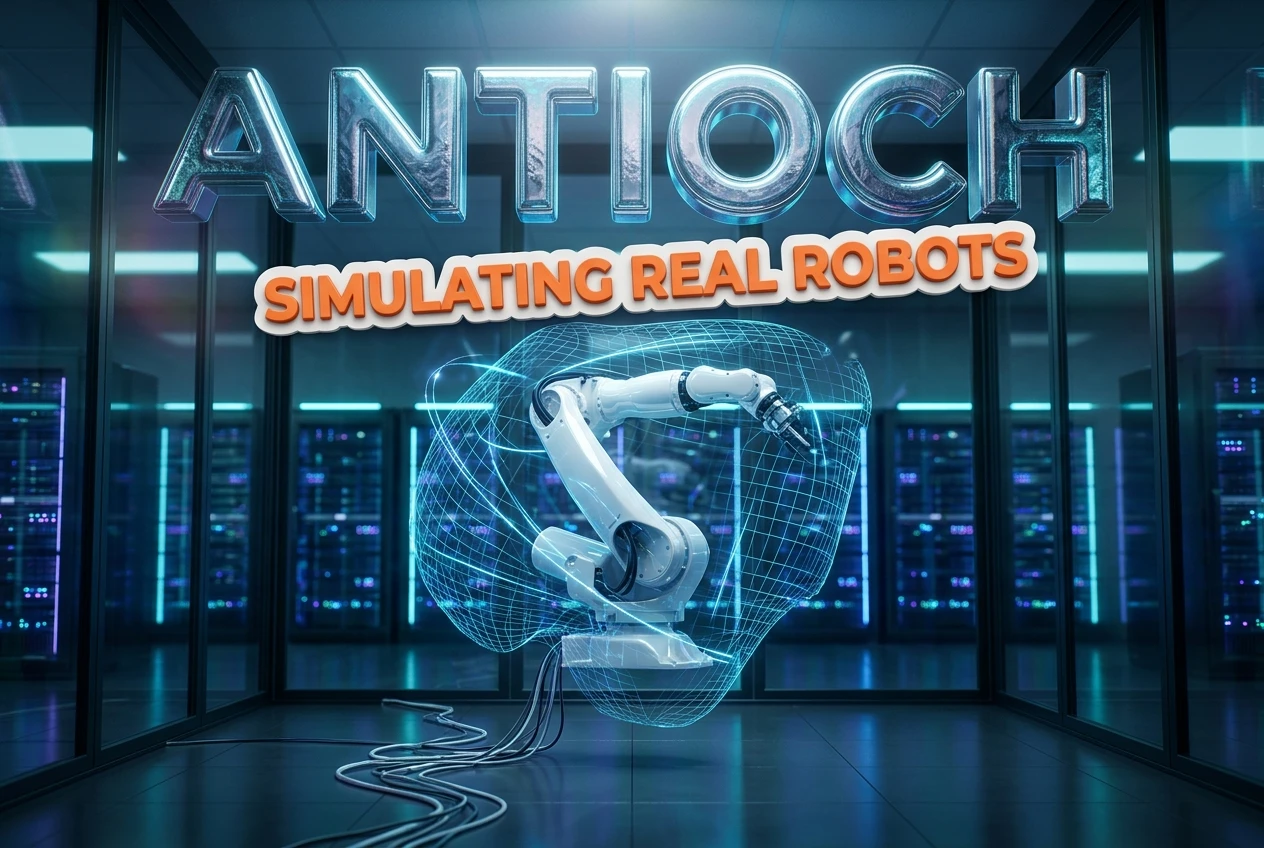
The pitch borrows a page from the coding world. Antioch executives compare their product to Cursor, the popular AI-powered software development tool. Antioch allows robot builders to spin up multiple digital instances of their hardware and connect them to simulated sensors that mimic the same data the robot’s software would receive in the real world.
Why the sim-to-real gap matters for robotics
Robotics is starved for data from the physical world. Companies still rent mock warehouses, wire up factory lines and shadow gig workers just to feed their deep learning models.
Antioch wants to close what the industry calls the sim-to-real gap, the challenge of making virtual environments realistic enough that robots trained inside them can operate reliably in the physical world.
The stakes are steep. The challenge here is making sure the physics in the simulation matches reality so that when the model is put in charge of a real machine, nothing goes wrong. A small error in a simulated sensor feed can send a forklift into a wall or a drone into a crowd.
Antioch’s engineers start with off-the-shelf world models and add their own secret sauce. The company starts with models built by Nvidia, World Labs, and others, and builds domain-specific libraries to make them easy to use. Working with multiple customers, executives say, gives Antioch a depth of context for refining its simulations that no single physical AI company could match on its own.
A Stanford-Tesla-DeepMind team behind the startup
Co-founder and Chief Executive Harry Mellsop cut his teeth on Tesla’s self-driving stack. At Tesla, he worked on computer vision and neural network systems for Tesla’s autonomous driving stack, including leading the driver monitoring program.
His co-founders bring deep AI pedigrees too. Former Google DeepMind engineer Colton Swingle was in charge of large-scale validation projects that involved simulating different kinds of infrastructure to test software products. Collin Schlager worked for Meta Platforms Inc.’s Reality Labs unit, where he was involved in building virtual simulations for product testing. Antioch’s fourth co-founder is Alex Langshur, who previously served as head of product at a startup called Deep Grey Research.
Mellsop and Langshur have built and sold a company before. Mellsop and two of his co-founders, Alex Langshur and Michael Calvey, previously founded a security and intelligence startup called Transpose Inc. that was acquired by Chainalysis Inc. in 2023. That company grew to serve a number of U.S. intelligence and law enforcement agencies.
Antioch’s founders see their work as more than a commercial play. Langshur said the country’s manufacturing capabilities have systematically eroded over the last 40 years due to endless offshoring. Under President Donald Trump’s administration, the country is now looking to reindustrialize as a national security imperative, but the problem is that companies don’t want to pay the excessive labor costs associated with domestic manufacturing.
Langshur argues automation is the only path forward. Speaking with SiliconANGLE, he said scalable testing has become the real bottleneck to rebuilding American factories at speed.
Investors see a GitHub moment for robotics
Venture money is flooding into physical AI, but the tooling layer is still thin. Venture capital poured over $6 billion into robotics startups last year according to PitchBook data, with humanoid robots, warehouse automation, and agricultural systems leading investment. But the developer tools layer remains thin compared to the mature ecosystem around pure software AI.
“Simulation is really important when you’re trying to build a safety case or dealing with very high-accuracy tasks. It’s not possible to drive enough miles in the real world,” said Adrian Macneil, founder of Foxglove and an angel investor in Antioch.
Category Ventures partner Çağla Kaymaz drew a sharp line between bugs in code and bugs in machines. In the physical world, a faulty model can break far more than a browser tab. That risk, she said, is why specialised dev tools for robots matter now.
What comes next for Antioch and physical AI
Antioch is zeroing in on the sensor stack first. Antioch’s focus now is mainly on sensor and perception systems, which account for the bulk of the need in automated cars and trucks, farm and construction machinery, or aerial drones. According to The Robot Report, the startup has already integrated with Nvidia’s Omniverse and Cosmos tools.
Researchers are putting the platform to creative use. David Mayo, a researcher at MIT’s Computer Science and Artificial Intelligence Laboratory, is using Antioch’s platform to evaluate LLMs. In one experiment, Mayo has AI models design robots, then use Antioch’s simulator to test them. It can even pit the models against each other in simulated contests, like pushing a rival bot off a platform. Giving the LLMs a realistic sandbox could help provide a new paradigm for benchmarking them.
Here are the verticals Antioch is targeting first:
- Self-driving cars and long-haul trucks that need billions of simulated miles.
- Construction and farm machinery operating in messy outdoor sites.
- Aerial drones where a single crash can end a pilot program.
- Smart home sensors and security cameras that must work in any lighting.
“We genuinely all think that anyone building an autonomous system for the real world is going to do so in software primarily in two to three years,” Mellsop said. “It’s the first time you can have autonomous agents iterate on a physical autonomy system, and actually close the feedback loop.”
Key Takeaway: Antioch is betting that robotics will move from hardware-first tinkering to a software-first workflow within three years, and it wants to be the default toolkit when that shift arrives.
Stats that show the scale of the opportunity
$6 billion poured into robotics startups last year, per PitchBook data.
$3.2 billion projected size of the robotics simulator market by 2030.
Hundreds of millions spent yearly by Tesla, Waymo and Anduril on simulation tools.
$60 million valuation placed on Antioch after its latest seed round.
Those numbers underline why industry watchers at citybiz see simulation as the next rung in the robotics infrastructure ladder. Market leaders in the autonomy space such as Tesla, Anduril, and Waymo spend hundreds of millions of dollars a year on end-to-end system evaluation. This creates a significant market opportunity, but it also puts these tools out of reach for smaller players and new entrants.
Antioch’s pitch is that any team, not just the richest labs, should get that same firepower. If it works, the economics of building a robot startup could change overnight. The company still needs to prove its physics can hold up outside the demo reel.
Mellsop is also a Kiwi founder. His personal site lists prior stints at Stanford AI, Tesla Autopilot and Transpose, giving Antioch a founder story that spans two hemispheres and three industries.
Frequently Asked Questions
What is the sim-to-real gap in robotics?
It is the gap between how a robot behaves in a virtual simulation and how it acts in the real world. Closing it lets developers train machines in software without dangerous surprises during deployment.
How much did Antioch raise in its seed round?
Antioch raised $8.5 million at a $60 million valuation, led by A* and Category Ventures, with MaC Venture Capital, Abstract, Box Group and Icehouse Ventures also taking part.
Who founded Antioch?
Stanford alumni Harry Mellsop, Alex Langshur, Michael Calvey, Colton Swingle and Collin Schlager. They bring experience from Tesla Autopilot, Google DeepMind, Meta Reality Labs and the Chainalysis-acquired startup Transpose.
What does Antioch’s product actually do?
It is a cloud simulation platform that creates digital twins of robots and their sensors, letting engineers run thousands of tests in parallel before touching real hardware.
Who is using Antioch today?
Customers include Fortune 500 enterprises and startups in construction robotics, smart security and foundation model AI. MIT’s CSAIL is also using the platform to benchmark large language models.
From a $4.25 million pre-seed in December to an $8.5 million seed just four months later, Antioch’s climb mirrors the pace of the physical AI wave itself. The company’s bet is simple: give every robot team the kind of simulation firepower that only Tesla, Waymo and Anduril can afford today. If the sim-to-real gap really closes in the next two to three years, the robots around us could learn faster than anyone expected. Share your thoughts in the comments below.

-
 TECH1 year ago
Where Garmin Watches are Made and How They are Assembled
-

 AUTO3 months ago
Tesla’s Roadster Is ‘a Few Weeks Away,’ Says Its Chief Designer
-
 NEWS10 years ago
Samsung Releases Galaxy Note7 TV Ad as Reddit AMA Leaks Specs
-
 NEWS10 years ago
Android 7.0 Nougat Rolls Out To Nexus Devices With New Emoji, Features
-
 FINANCE9 years ago
Cardano Price Surges as ADA Enters the Crypto Top Ten List
-
 NEWS10 years ago
Pre-Order the First Camera Made for Facebook Live Streaming Video
-
 FINANCE1 year ago
Binance Suspends Trading and Withdrawals for a System Upgrade
-
 FINANCE9 years ago
RChain Price Jumps Nearly 150% to a New All-Time High of $2.03