
NEWS
San Francisco AI Billboards Show Industry’s New Swagger

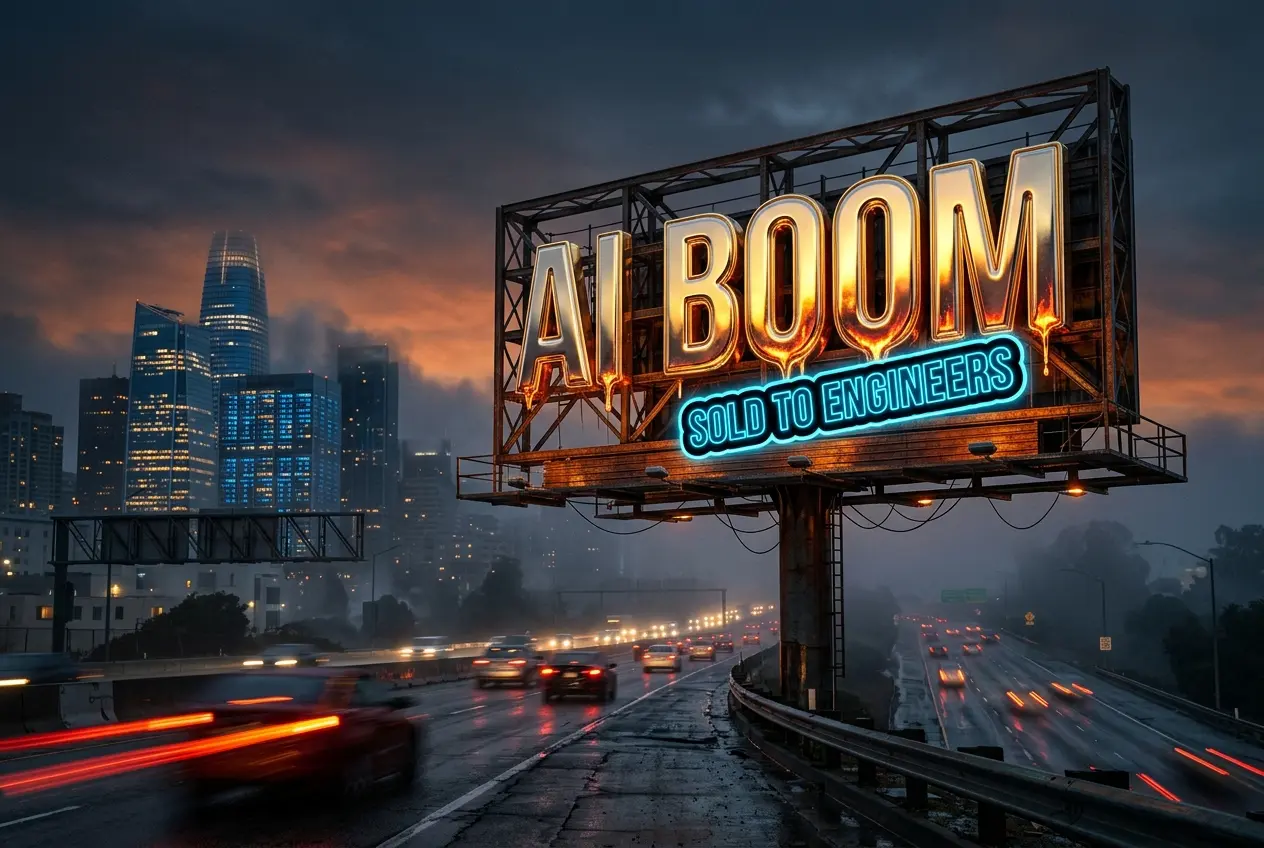
San Francisco’s freeways now look more like a tech trade show than a city. Roughly half of the billboards across town push artificial intelligence apps, platforms, or infrastructure, according to a recent San Francisco Chronicle survey. The signs boast cash and swagger, yet mostly skip the touchy stuff about safety and lost jobs. What they reveal is a clear snapshot of the AI boom right now.
At a Glance:
- About half of all San Francisco billboards now advertise AI companies.
- Global AI startup funding hit $270.2 billion in 2025, per BestBrokers.
- 91% of organizations already deploy AI agents, Okta reported in September 2025.
- Highway 101 holds 170 billboards across three Bay Area counties, per Caltrans.
A city wallpapered in AI pitches
The AI advertising surge is impossible to miss. There are 170 billboards along Highway 101 in San Francisco, San Mateo, and Santa Clara counties, according to Caltrans Outdoor Advertising. Many of them now speak only to tech insiders.
Demand is running ahead of supply. Billboard rental revenue in the city grew by around 30% between 2023 and 2025, according to data provided by the outdoor advertising company Outfront Media. Advertisers said they are waiting many months for spots in the most desirable locations to open up.
Premesh Purayil, chief technology officer at outdoor advertising company Outfront, said the past 18 months have seen a surge of AI companies spending on billboards, particularly in downtown San Francisco and near tech campuses. That ad-space gold rush mirrors the flood of venture cash hitting AI labs, with startup marketers chasing every unclaimed square foot of roadside glass. The city’s visual identity is shifting in step with its balance sheet.
Who the ads are really talking to
These messages are not aimed at everyday drivers. They are coded notes to engineers, chief information officers, and venture partners. Slogans such as “Own Your Models,” “Intelligent AF,” and “Agents Don’t Work Without Evals” now fill expensive city real estate once reserved for mainstream brands like Coca-Cola or Toyota.
A few lines captured on recent drives give a sense of the tone:
- “Own Your Models” from AI infrastructure startup Baseten.
- “Agents don’t work without evals,” aimed at machine learning engineers.
- “Too much B2B SAAS,” a wink at software buyers.
- “Stop firing humans,” a rebuttal campaign from ServiceNow.
Baseten is one of the most visible names on the streets. “The goal is intentional in a kind of ‘if-you-know-you-know’ type of way,” Mike Bilodeau, head of marketing at the AI infrastructure startup Baseten, told NPR. “For a lot of folks, the ads don’t really mean anything.”
Not everyone finds the strategy charming. “I look at these billboards and have absolutely no idea what they’re advertising,” said Louise Mozingo, who runs the urban design program at the University of California, Berkeley, and has studied the tech sector in the context of corporate landscaping extensively over the years. “They’re quite clearly not advertising to the average consumer.” The real product being sold is legitimacy, not reach, and that shifts the entire calculus of outdoor advertising.
The money powering the ad blitz
Billboards follow the cash, and the cash is historic. Venture capital investment in AI reached $270.2 billion in 2025, marking the first year in which funding for artificial intelligence exceeded half of all VC deal value, accounting for 52.7% of the total $512.6 billion invested by venture capital firms.
San Francisco captured the lion’s share. Of the $126 billion invested in local startups, $113 billion flowed to only 92 companies that raised rounds of $100 million or more, led by none other than OpenAI, Anthropic, xAI, Scale AI, Anysphere, Thinking Machines Lab, and Safe Superintelligence. You can read a breakdown in Crunchbase’s Q1 2026 foundational AI funding analysis.
Mega-rounds keep pushing valuations to record levels. The investment tripled Anthropic’s valuation from $61.5 billion to $183 billion, making it the second most valuable private AI company in the world, behind OpenAI, which was valued at $300 billion at the time of the deal and has since reached $500 billion.
Billboard budgets are a rounding error next to these rounds. A $200,000 outdoor campaign is pocket change for a company sitting on half a billion in fresh capital. That math explains why every blank wall in SoMa now carries a logo.
Stats Snapshot
$270.2B poured into global AI startups in 2025, per BestBrokers data.
$126B of that went to Bay Area firms, according to Crunchbase.
$500B OpenAI’s current valuation, the highest of any private AI company.
30% rise in San Francisco billboard rental revenue from 2023 to 2025.
Safety, trust, and the missing debate
Despite the flood of ads, almost none mention AI safety or governance. The main exception is a sign from Okta that reads, “Build and secure AI agents from day one.” The company sells identity and permission systems that keep rogue agents away from sensitive data, as detailed in its September 2025 identity security fabric announcement.
The need for those tools is growing fast. AI agents, already in use by 91% of organizations, promise immense productivity gains but also amplify existing security gaps and introduce new classes of risk. Despite this, governance of AI is lagging, with only 10% of organizations having a strategy for managing non-human identities.
“AI is changing the workplace faster than organizations can adapt. We’re starting to see poorly built, deployed, or managed agents expose the risks of using a traditional patchwork of identity solutions,” said Kristen Swanson, SVP of Design and Research, Okta.
Humans, jobs, and the public backlash
One campaign pushed the human angle into the open. The anti-human sentiment dates back to a 2024 campaign by San Francisco-based Artisan AI featuring the message, “Stop hiring humans.” The company later detailed the plan in its own Artisan AI marketing retrospective.
Public reaction was sharp. According to a 2025 Reuters/Ipsos poll, more than 70% of adults surveyed fear that AI will be “putting too many people out of work permanently.”
Rivals quickly flipped the script. The backlash against “Stop hiring humans” has brought us “Stop firing humans.” “We’ve seen an influx of billboards focused on replacing people with AI. We fundamentally disagree with that narrative, so what better place to say it?” said a ServiceNow spokesperson, noting that “AI should work for people, not instead of them.”
Residents outside tech feel the tension every day. Ian Molloy, a paraeducator at a San Francisco public school, said he sees the billboard advertisements for AI every single day. “You see them and feel this existential dread about this whole block of AI,” he said.
Key Takeaway: The billboards map a $270 billion industry that has mastered enterprise sales but still struggles to speak to the workers, regulators, and residents watching from the sidewalk.
Frequently Asked Questions
Why are there so many AI billboards in San Francisco?
AI startups are flush with venture cash and use outdoor ads to signal legitimacy to other tech buyers. Billboard rental revenue in the city grew about 30% between 2023 and 2025, according to Outfront Media.
Who are these cryptic AI ads actually for?
They target engineers, chief information officers, and venture investors, not the general public. Baseten’s marketing lead Mike Bilodeau said the strategy is an intentional “if-you-know-you-know” approach.
How much money is flowing into AI right now?
Global AI funding reached $270.2 billion in 2025, or 52.7% of all venture capital, per BestBrokers. The Bay Area alone captured $126 billion of that total.
Do any billboards talk about AI safety?
Almost none do. Okta is a notable exception, advertising identity tools to secure AI agents at a time when only 10% of organizations have a strategy for managing non-human identities.
What was the “Stop hiring humans” controversy?
Artisan AI’s 2024 billboard campaign told companies to replace workers with AI agents, triggering backlash. Rivals responded with the counter-slogan “Stop firing humans.”
San Francisco’s AI billboards are more than wallpaper; they are a ledger of where the industry’s $270 billion in capital is going and who it is talking to. The signs shout confidence while leaving safety and jobs at the edge of the frame, a gap that regulators and residents are unlikely to ignore forever. What do you think the next wave of AI billboards will say? Share your take in the comments.

-
 TECH1 year ago
Where Garmin Watches are Made and How They are Assembled
-

 AUTO3 months ago
Tesla’s Roadster Is ‘a Few Weeks Away,’ Says Its Chief Designer
-
 NEWS10 years ago
Samsung Releases Galaxy Note7 TV Ad as Reddit AMA Leaks Specs
-
 NEWS10 years ago
Android 7.0 Nougat Rolls Out To Nexus Devices With New Emoji, Features
-
 FINANCE9 years ago
Cardano Price Surges as ADA Enters the Crypto Top Ten List
-
 NEWS10 years ago
Pre-Order the First Camera Made for Facebook Live Streaming Video
-
 FINANCE1 year ago
Binance Suspends Trading and Withdrawals for a System Upgrade
-
 FINANCE9 years ago
RChain Price Jumps Nearly 150% to a New All-Time High of $2.03