
BUSINESS
India’s Rs 37,500 Crore Coal Bet Hinges on the Jindal Template

India’s Union Cabinet on Wednesday cleared a Rs 37,500 crore (about $4.5 billion) incentive package to convert domestic coal into the feedstock the country currently spends Rs 2.77 lakh crore (roughly $33 billion) a year importing as liquefied natural gas (LNG), ammonia, methanol, and urea. The scheme targets 75 million tonnes of annual coal and lignite gasification capacity, caps a single project at Rs 5,000 crore, and extends coal supply linkage to 30 years, signalling that New Delhi sees this as long-cycle bridge infrastructure rather than a one-off subsidy.
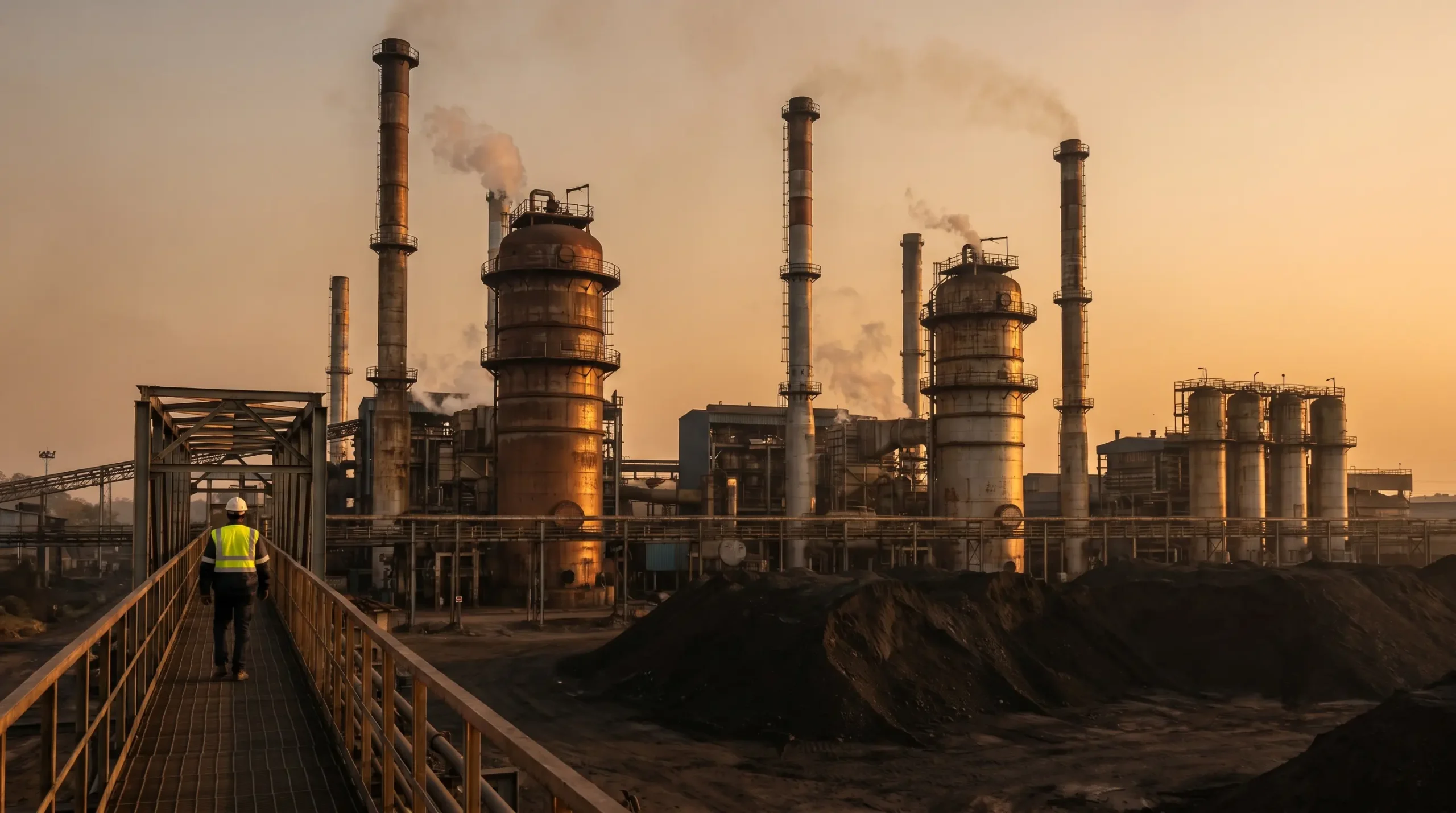
The bet has exactly one working template, and it sits in Angul, Odisha. Jindal Steel & Power’s integrated plant is the only commercial-scale coal gasification facility operating in India today, representing roughly 2% of the 2030 national capacity goal. Every other player named in this push, from Adani to NTPC to Coal India, has yet to ship syngas at industrial scale.
What the Cabinet Cleared on Wednesday
The Scheme for Promotion of Surface Coal and Lignite Gasification Projects replaces a much smaller 2024 package, and the numbers tell you how far policy ambition has moved. The Observer Research Foundation’s analysis of India’s coal gasification policy stack notes that the new outlay sits alongside the Union Budget 2026-27 allocation of Rs 20,000 crore for carbon capture, utilisation and storage (CCUS) work in heavy industry.
The Cabinet also imposed three caps to keep benefits from concentrating in a single group.
| Provision | 2024 Scheme | 2026 Scheme |
|---|---|---|
| Total financial outlay | Rs 8,500 crore | Rs 37,500 crore |
| Maximum aid per project | Rs 1,000 crore (private), Rs 1,350 crore (PSU) | Rs 5,000 crore (uniform) |
| Cap per single product category | Not specified separately | Rs 9,000 crore (excl. synthetic natural gas, urea) |
| Cap per entity group | None disclosed | Rs 12,000 crore |
| Target capacity | Eight pilot projects | 75 million tonnes annual |
| Coal linkage tenure | Standard auction terms | Up to 30 years |
Project selection runs through competitive bidding benchmarked on coal input and syngas output, with incentives paid in four equal milestone-linked instalments. The Centre projects roughly 50,000 direct and indirect jobs, and about Rs 6,300 crore in annual revenue from gasifying 75 million tonnes, excluding downstream goods and services tax (GST) and royalties.
The Rs 2.77 Lakh Crore Import Bill in the Background
The economic logic is uncomplicated. In financial year 2024-25, India spent close to Rs 2.77 lakh crore importing the exact basket of commodities that syngas-derived chemistry can produce domestically, and the bill went up every time a tanker route through the Strait of Hormuz got nervous. The West Asia conflict tightening LNG supply this spring has pushed the question from theoretical risk to active policy pressure.
- ~100% of ammonia is imported, the highest single-input exposure in the basket.
- 80 to 90% of methanol consumption is met from imports.
- ~50% of liquefied natural gas demand is bought offshore.
- ~20% of urea continues to come in via imports despite domestic capacity additions.
- ~89% of crude oil is still imported, the larger structural backdrop the scheme is acting against.
If domestic syngas can substitute even half of that basket over a decade, India saves Rs 60,000 to 90,000 crore annually, according to ORF Online’s reading of the policy. That is the rough boundary of the prize.
Angul Already Runs the Playbook the Scheme Wants
On April 6, Jindal Steel & Power said its Angul facility had become the first integrated steel plant in India to deploy coal gasification across an entire steelmaking value chain. That announcement matters more this week than it did six weeks ago, because the new Cabinet outlay is essentially a public-finance bet that 25 more projects can do what Angul does.
JSP’s syngas runs in three places, each tackling a different imported fuel that the steel sector has bled foreign exchange on for two decades:
- Direct Reduced Iron (DRI) plant: India’s first coal gasification-based DRI route, where syngas reduces iron ore in place of imported natural gas.
- Galvanising and colour-coating line furnaces: a global first in the steel sector, replacing LPG and propane that have faced repeated supply shocks.
- Blast furnace injection: syngas is fed into the blast furnace, cutting coking-coal consumption in a country that buys nearly 90% of its coking coal from Australia.
“Synthesis gas from swadeshi coal can replace imported methanol, ammonia, ammonium nitrate, and LNG,” P.K. Biju Nair, Executive Director at Jindal Steel’s Angul plant, said in the company’s April announcement. The Angul facility plans to scale from 6 MTPA to 25.2 MTPA by 2030, with at least half of that volume routed through the gasification-DRI-electric arc furnace pathway.
Why the 2024 Push Stalled
The harder lesson the Cabinet is trying to learn sits in the previous scheme’s spending file. Of the Rs 8,500 crore approved in January 2024, eight projects worth Rs 6,233 crore are formally under implementation. But Ministry of Coal records show that almost the entire Rs 285 crore allocated under the revised estimate for 2025-26 went unspent through early 2026, despite headline approvals.
The bottleneck has been everything except money. The Talcher Fertilizers coal gasification revival, announced years before, is still not commissioned. Land acquisition has been slow, and the first dedicated coal block linked specifically to gasification was only signed in April 2026, when Bharat Coal Gasification and Chemicals Limited and Mahanadi Coalfields Limited inked a land-lease agreement at Lakhanpur, Odisha, for an ammonium nitrate plant.
The 30-year linkage tenure in the new scheme is a direct response to that history. Long fuel-supply certainty is what private capital has been asking for; the question now is whether project gestation, which has typically run five to seven years from approval to first syngas, can be compressed enough to land tonnage before the 2030 deadline the government keeps repeating.
High-Ash Coal Is the Engineering Headache
The other reason the 2024 attempt stalled is that Indian coal is the wrong shape for most of the world’s gasification equipment. Ash content in domestic reserves runs as high as 40% in some coalfields, while standard gasifier designs are economically viable below roughly 30%.
That gap is why so much of the new policy paperwork is about indigenous technology. The Lakhanpur project uses gasifier technology developed by Bharat Heavy Electricals Limited (BHEL, the state-owned heavy engineering firm), the first significant deployment of a domestically engineered system designed for high-ash feed. The new scheme is technology-agnostic on paper, but the Coal Ministry has explicitly said indigenous technologies will be preferred.
India sits on roughly 400 billion tonnes of coal reserves and 47 billion tonnes of lignite reserves, among the largest in the world. The combination of large reserves with awkward chemistry is exactly the problem BHEL, IIT-led research programmes, and indigenous engineering houses are now being asked to solve at commercial scale, not pilot scale. If they cannot, every other line item in the scheme starts to wobble.
Adani, NTPC, and Coal India Join the Queue
Private and state-owned capital is already lining up behind the scheme even before the first bid window. The pipeline reads like a stress test of the Indian heavy-industry balance sheet.
| Player | Project / commitment | Status |
|---|---|---|
| Adani Group | Rs 70,000 crore coal-to-chemicals plant, Nagpur | Under construction; will produce syngas, ammonia, hydrogen |
| NTPC | 5 to 10 million tonnes of synthetic gas annually | Three to four-year build-out plan |
| Coal India | Approximately Rs 1 trillion capex over FY27 to FY31 | Includes gasification, clean energy, thermal |
| Bharat Coal Gasification & Chemicals (with MCL) | Ammonium nitrate plant, Lakhanpur, Odisha | Land lease signed April 2026 |
| New Era Cleantech Solutions | Rs 20,000 crore coal-to-chemicals project | Announced, pre-construction |
| Essar Oil & Gas E&P | $100 million in Raniganj East coal bed methane block | Producing approximately 1 mmscm/day of gas |
Together, government estimates put the investment that could be unlocked between Rs 2.5 lakh crore and Rs 3 lakh crore over the coming years, with approximately 25 large projects in coal-bearing states. The Centre is also banking on around 50,000 direct and indirect jobs, particularly in Odisha, Chhattisgarh, Jharkhand, and West Bengal, the regions where most syngas pilots have clustered.
The scale is meaningful but still small against the global benchmark. China processes roughly 350 million tonnes through coal gasification today, producing about 70% of its methanol and over 90% of its ammonia through the route. India’s 100-million-tonne target for 2030 is less than a third of China’s current footprint.
The Carbon Bill the Spreadsheet Doesn’t Show
The trade-off the official briefing skipped past is the one outside the customs ledger. Chemical & Engineering News reporting on coal-to-chemicals greenhouse-gas intensity argues that gasifying coal to make methanol is significantly more carbon-heavy than making the same molecule from natural gas.
The emissions intensity is around five times higher from coal to methanol versus natural gas to methanol.
That was Joe Hittinger, project manager for chemicals at Global Energy Monitor, speaking to C&EN last summer. ORF cites India’s Steel Decarbonisation Roadmap to show the same pattern in steel: emission intensity on the syngas-based DRI route works out to 2.50 to 2.90 tonnes of CO2 per tonne of crude steel, higher than the conventional blast-furnace-basic-oxygen route at 2.20 to 2.60 tCO2/tcs.
That is the headline tension. Coal gasification reduces foreign-exchange exposure and shields agriculture and manufacturing from LNG price spikes, but on a per-molecule basis it raises the carbon footprint of products India already makes from imports. The Rs 20,000 crore CCUS allocation in Budget 2026-27 is the policy hedge, except the Institute for Energy Economics and Financial Analysis has flagged CCUS deployments globally as persistently underperforming on cost and capture rates. Steelmakers exporting to Europe will also have to manage the European Union’s Carbon Border Adjustment Mechanism, which prices in exactly this kind of embedded emission.
If the next 25 projects scale the Angul model with carbon capture wired in from day one, the scheme delivers on both the import-substitution and the climate-arithmetic side, and the Rs 60,000 to 90,000 crore annual savings story holds. If they replicate the 2024 stall, with eight headlines and one operating plant, the country ends 2030 with a bigger coal habit, the same import bill, and a heavier audit from Brussels. The next twelve months of bid announcements, BHEL gasifier orders, and Talcher recommissioning updates will tell which way the bet is breaking.

-

 AUTO2 months ago
Tesla’s Roadster Is ‘a Few Weeks Away,’ Says Its Chief Designer
-
 TECH1 year ago
Where Garmin Watches are Made and How They are Assembled
-
 NEWS10 years ago
Samsung Releases Galaxy Note7 TV Ad as Reddit AMA Leaks Specs
-
 NEWS10 years ago
Android 7.0 Nougat Rolls Out To Nexus Devices With New Emoji, Features
-
 FINANCE9 years ago
Cardano Price Surges as ADA Enters the Crypto Top Ten List
-
 NEWS10 years ago
Pre-Order the First Camera Made for Facebook Live Streaming Video
-
 FINANCE12 months ago
Binance Suspends Trading and Withdrawals for a System Upgrade
-
 FINANCE9 years ago
RChain Price Jumps Nearly 150% to a New All-Time High of $2.03